The Label on the Box
A Documented History of the Original STEM/STEAM Product Standard
In this essay +
- The Initial Question
- How a Label Gets on a Box
- The Authentic Record, 2014 Onward
- The Committee, 2018
- The Report, 2019
- The Public Acknowledgment and the Webinar, February–October 2019
- The Call, November 8, 2019
- The Launch, August 2, 2021
- The Best Case for the Other Side
- The Aftermath, 2023
- The Economics of Integrity
- Stewardship

Independent review disclosure: This article provides independent quality-assurance coverage. It is not a paid promotion or affiliate partnership, and STEM.org receives no commissions from its product links. Any recognition is limited to its documented scope.
Author’s Note. This essay documents the history of STEM.org Educational Research’s work in STEM/STEAM product authentication, based on contemporaneous email correspondence, business records, published reports, retail packaging, and direct communications with industry participants. Factual claims are sourced to documents in STEM.org’s possession or to the Toy Association’s own publications; exhibits appear inline throughout and are itemized at the end. Where a claim rests on my recollection rather than a document, I say so plainly.
In the interest of brevity, what appears here is a representative selection of the record, not its entirety. Substantial additional documentation — correspondence, business records, and related materials — exists and is held securely by third-party counsel.
This account reflects my perspective as a participant in these events. The individuals and organizations named here may recall or interpret them differently. This essay makes no legal accusations; it is a chronological record of documented business interactions and their outcomes, published so that the toy and STEM education communities can know their own history.
The Initial Question
The toy industry did not learn about STEM from a trade association. It learned by asking — and beginning in early 2014, manufacturers started asking us.
By then, STEM.org Educational Research had spent more than a decade working with students and teachers when toymakers began arriving with a question nobody had a process for: Can you verify that this product actually is what the box says it is? The word “STEM” had started to sell, and nobody owned a definition of it. There was no standard, no test, no referee — only a four-letter acronym appreciating in value on packaging, and a vacuum where verification should have been.
We have been evaluating products since the first quarter of 2014 — a fact I stated in writing to industry colleagues in September 2019, years before there was any dispute worth dating things for (Exhibit E, below). In September 2015, we formalized the protocol that became the world’s first STEM Product Trustmark Program, an anniversary we have marked publicly ever since. One of the earliest products to carry our mark was Game of the States, the classic family game from Winning Moves USA: our seal printed on every retail box, beside the age rating and the player count, backed by a fifty-second commercial. The mark was not theoretical. It shipped and you can still buy copies in specialty toy stores and on eBay.
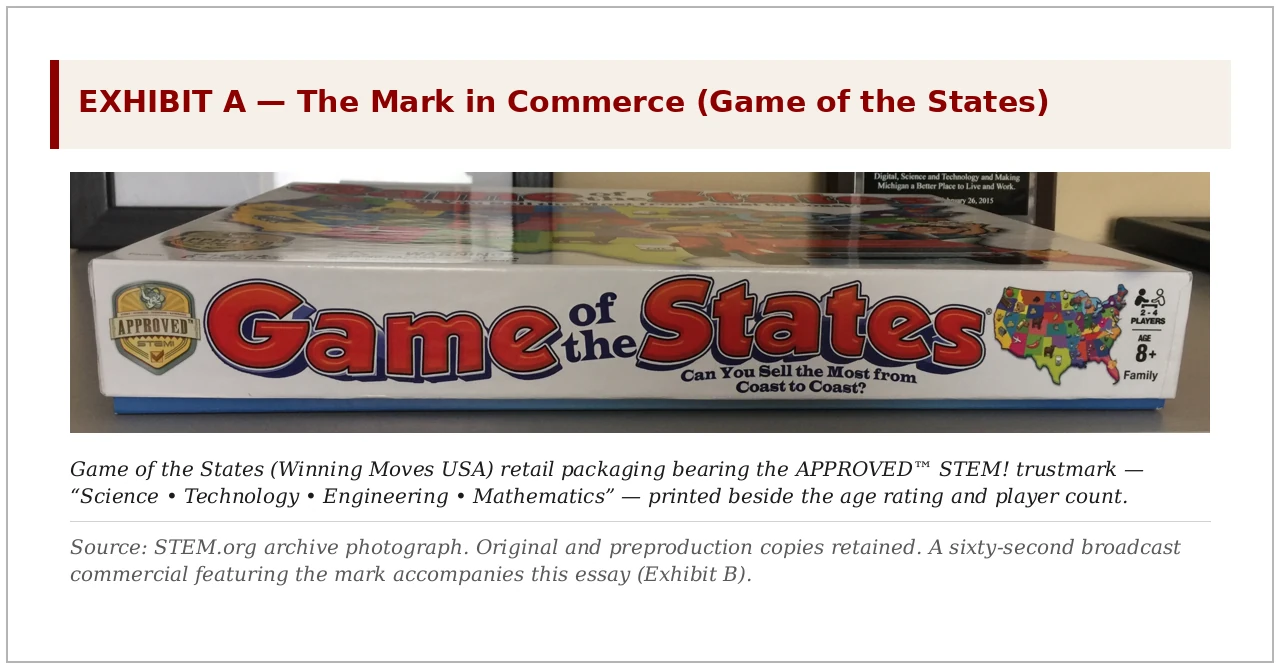
This essay is about what happened inside the vacuum we filled: who contributed to filling it, who later claimed to have filled it first, and what the documents say about the difference.
A disclosure is owed at the outset. As the founder of an organization that issues product trustmarks, I am an interested party in this account, not a disinterested chronicler of it. What follows is therefore offered as documented testimony rather than neutral history — each material claim supported by an exhibit and held on file. Whether the record bears the weight I place on it is for the reader to judge.
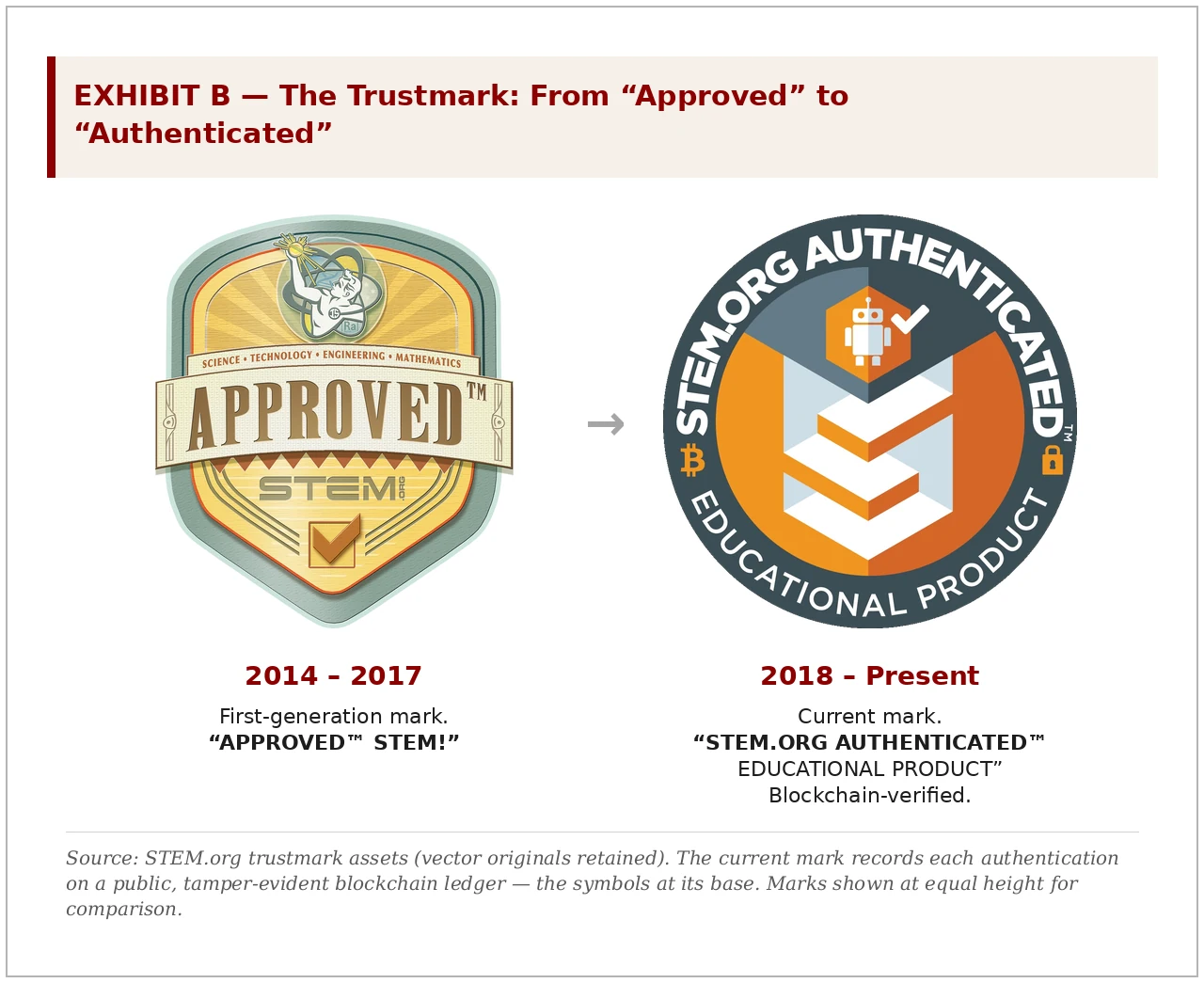
From the beginning, the mark carried the language of verification — “Approved,” then “Authenticated” — long before any trade association entered the field.
How a Label Gets on a Box
Strip away the branding, and every educational seal program reduces to the same five-step mechanism. A manufacturer makes a claim — this teaches engineering. A validator applies criteria to the claim. Money changes hands. A mark goes on the box. And a parent in a store aisle, with eleven seconds and a birthday party on Saturday, outsources her judgment to that mark.
Every corruption in the seal economy lives in step three. If the validator’s revenue depends on the manufacturer’s satisfaction — membership dues, booth fees, sponsorships, advertising — the criteria will bend. Not all at once, and never in writing. But bend they will. The test for any seal program is three questions: What does it cost? What do the criteria say? How often does the validator say no? A program that will not answer all three in public is asking parents to trust a black box with their children’s shelf space.
Keep those three questions in mind. They are the lens for everything that follows.
The Authentic Record, 2014 Onward
Between 2014 and 2019, STEM.org issued product trustmarks in direct collaboration with a documented roster of manufacturers — among them Learning Resources, hand2mind, Insect Lore, Turing Tumble, Magformers, Modular Robotics, Geomagworld, and HueHD — alongside retail integration with Staples, Inc., which adopted “STEM.org Approved / Authenticated” terminology on its product pages and in over 400 stores. By 2019, more than 200 manufacturers were shipping over 650,000 units monthly bearing our seal, with each credential cryptographically sealed against alteration — including our own.
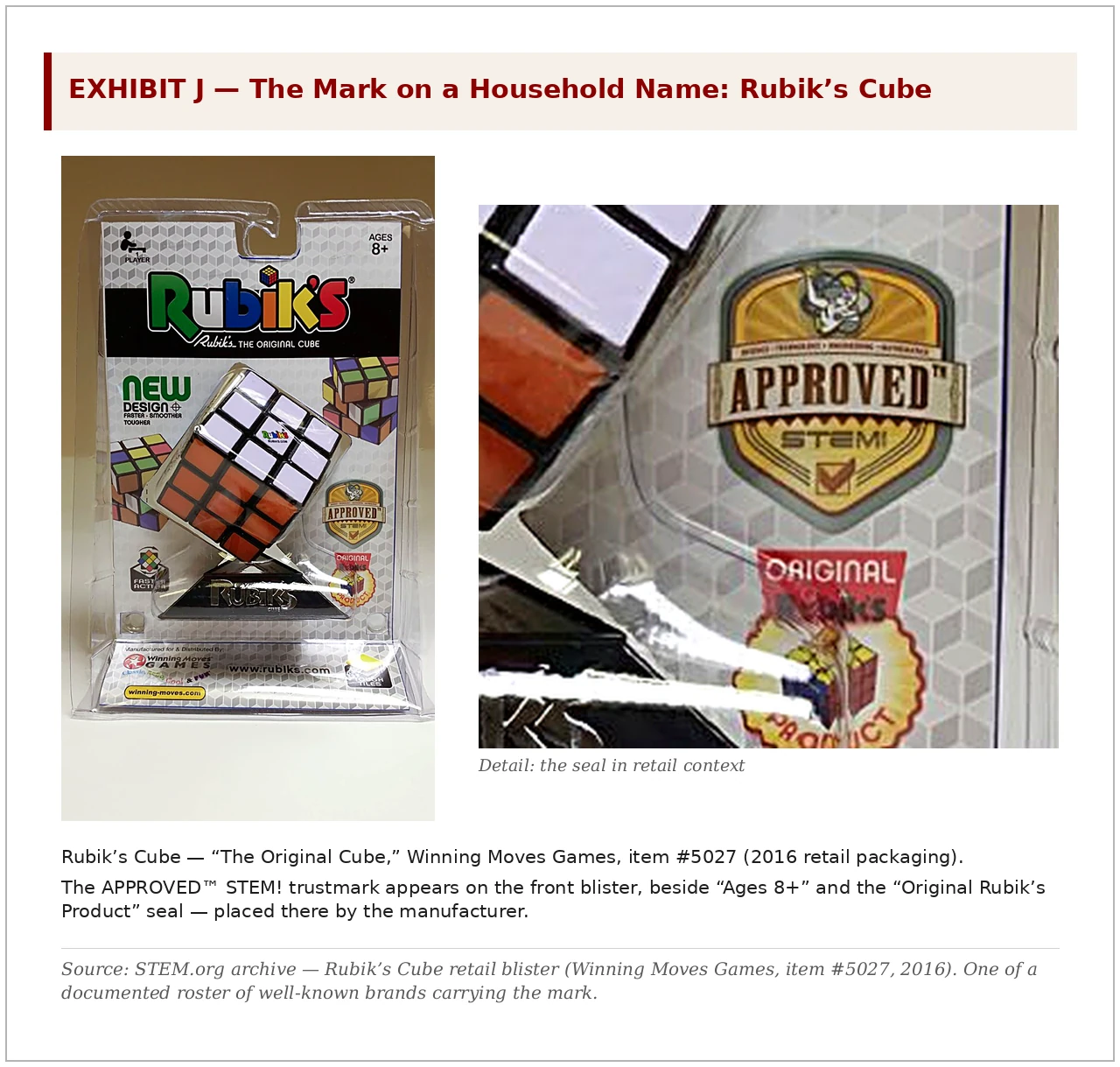
The mark was not confined to a single title. It appeared on Rubik's Cube — one of the most recognized toys in the world — in 2016, printed on the retail blister beside the brand's own "Original Product" seal.
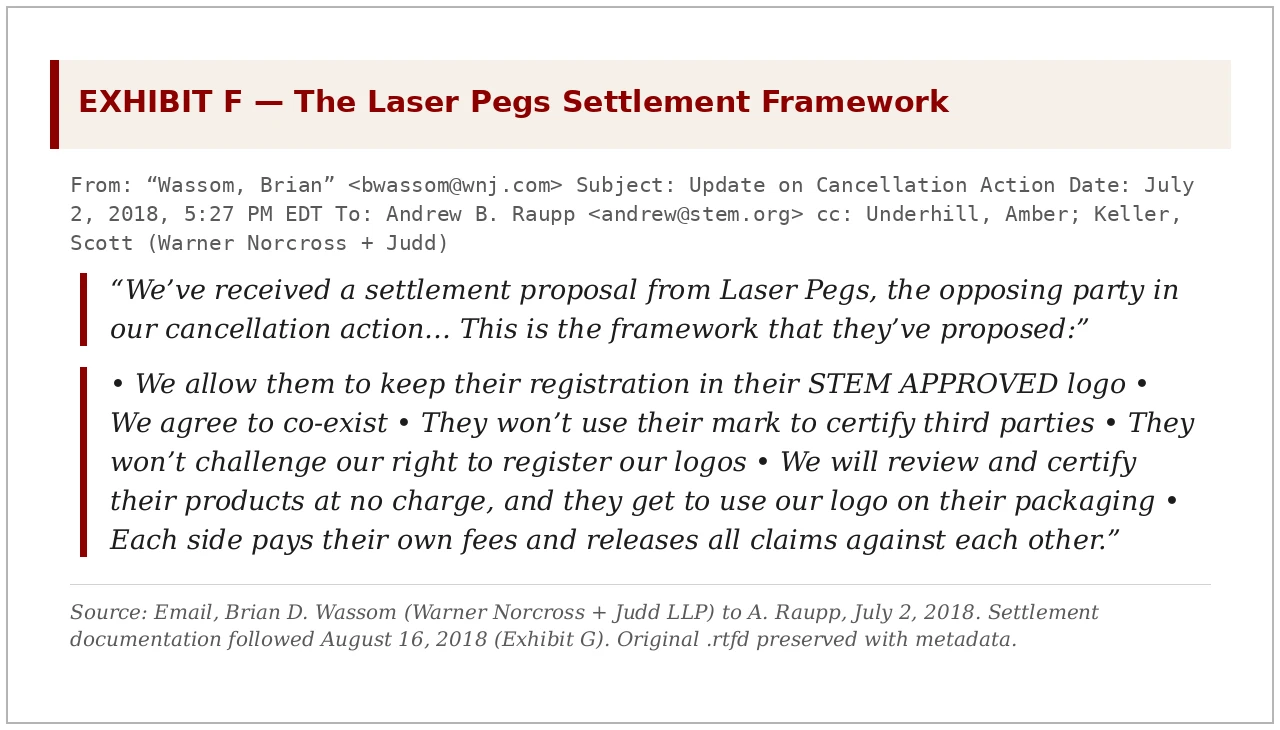
The category grew valuable enough to fight over. In 2017–2018, STEM.org pursued a trademark cancellation action concerning a “STEM APPROVED” logo registration held by the toy company Laser Pegs, represented by Brian D. Wassom of Warner Norcross + Judd and Paul M. Mersino of Butzel Long. The matter resolved in a 2018 settlement establishing co-existence: Laser Pegs retained unto its registration (now dead) but agreed not to use its mark to certify third parties, while STEM.org’s right to register its own marks and authenticate other products went unchallenged.
The episode mattered for two reasons. First, it confirmed that by 2017 the certification space we had built was worth contesting. Second, the uncertainty it created prompted us to do something no trade body had thought to do: we put the nomenclature question to the community itself. In 2017, the manufacturers we served weighed in on the language of STEM product validation. The standard wasn’t ours alone anymore. It was theirs.
We also accumulated, methodically, the vocabulary of the field: more than 300 domains related to STEM credentialing, including STEMApproved.org, .com and .net, STEM.toys, STEM.games, STEM.education, STEAMeducation.com, STEAMEducation.org — and STEAM.org. Remember that last one.
The Committee, 2018
In 2018, the Toy Association came to us. Twice. On June 1, 2018, following a conversation with Anna Yudina, the Association’s Director of Marketing Initiatives, I submitted my bio and references for the Toy Association’s STEM/STEAM Strategic Leadership Committee. Her reply, the same day, in writing:
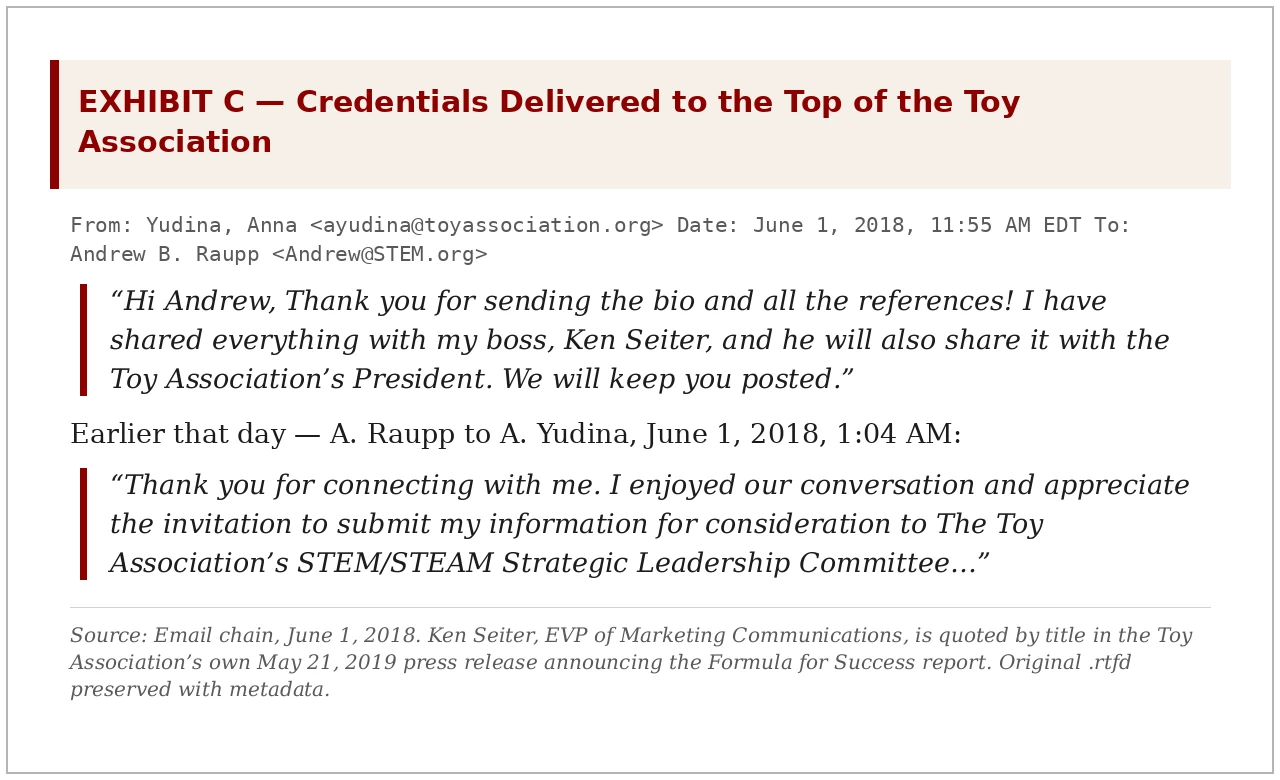
Read that exchange again. By June 2018, my organization’s full credentials — and references from the manufacturers we served — sat on the desks of the Toy Association’s Executive Vice President of Marketing Communications and its President. Whatever happened afterward, no one at the top of that organization could later claim not to know who we were or what we had built.
Separately, the Association’s framework project was underway. Its consultant, Jean Bailey — lead author of the Association’s STEM/STEAM criteria reports — interviewed STEM.org during her research. I want to be precise here, because precision matters: I make no accusation against Ms. Bailey, a contractor doing the job she was hired to do. The point is structural, not personal. Our organization’s benchmarks and experience were provided as foundational research input to the reports she authored. I stated exactly that, in writing, to industry colleagues in September 2019 — eighteen months before the Association launched a competing mark, in an email written as a friendly observation between partners:
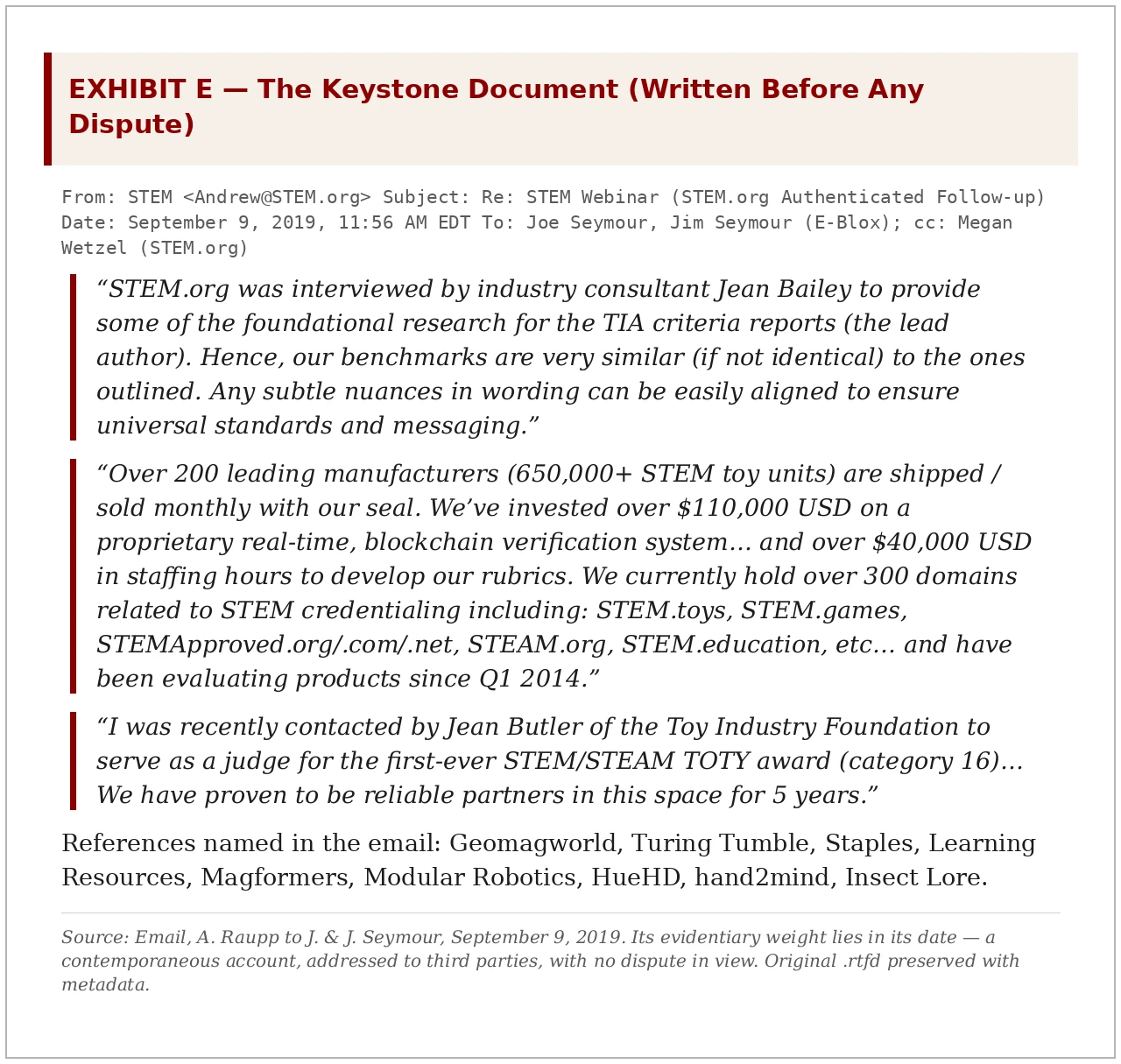
I was also invited, through Jean Butler of the Toy Industry Foundation, to serve as a judge for the first STEM/STEAM TOTY award category — a role I went on to fill for multiple years. By every visible signal in 2018 and 2019, STEM.org was inside the tent: contributing feedback, judging awards, advising panels.
The Report, 2019
In May 2019, the Toy Association published STEM/STEAM Formula for Success, the second report of its initiative, announcing “14 unifying characteristics” of a good STEM/STEAM toy, a parent survey, and an evaluation worksheet.
The report contains no bibliography. No footnotes. No references section. Not one citation of any prior research, methodology, or standard — not ours, not anyone’s. The sole attribution mechanism in the entire document is Appendix B, a single page thanking companies that contributed “via an in-depth interview and/or panel participation.”
STEM.org appears clearly on that list.
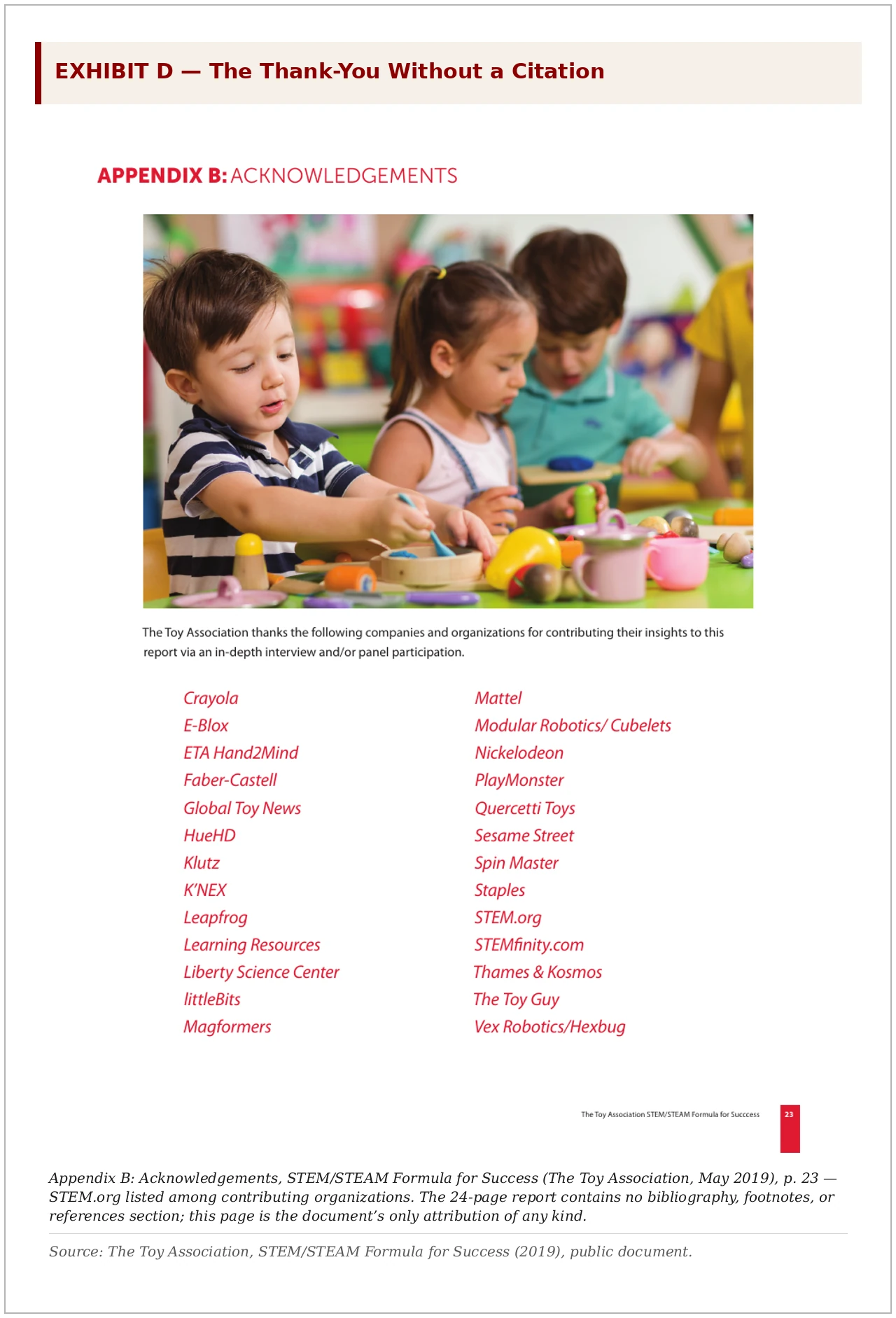
So here is the documented asymmetry, in one sentence: an organization that had been evaluating STEM products since 2014, whose benchmarks were provided as notable research to the report’s lead author, received — in a document defining the standards of the category it pioneered — a one-line thank-you, and nothing more.
When I raised the citation gap with the Association, I was told it would be addressed by Ken Seiter. It never was. I am stating this from recollection; the conversation was by phone. The published report, unchanged, speaks for itself.
The Public Acknowledgment and the Webinar, February–October 2019
By 2019, STEM.org’s role in the toy industry was not a private arrangement — it was acknowledged from the Association’s own stage. At Toy Fair New York that February, the Toy Association convened a panel titled “What Makes a Toy a STEM/STEAM Toy?” Among the panelists was Tom Runtz, Director of Product Development at Learning Resources, who told the audience that his company worked closely with STEM.org and had more than seventy of its products STEM authenticated (Exhibit G). The statement was made on an industry-association stage, on the record, years before any dispute — a major manufacturer affirming both the relationship and its scale in plain terms.
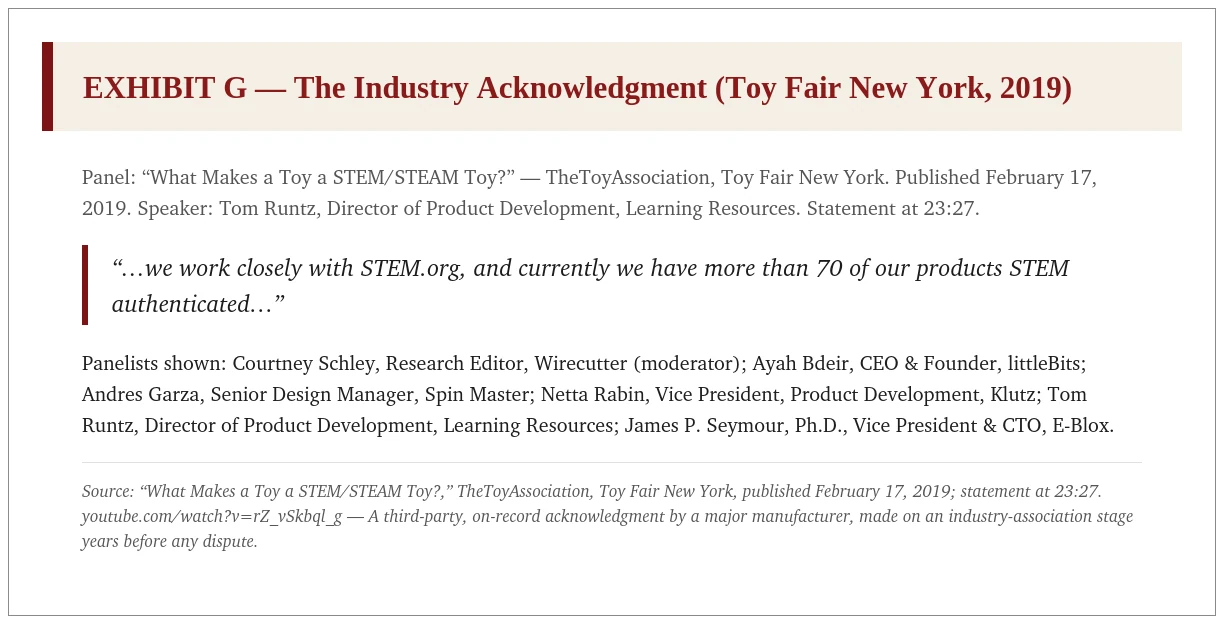
Also seated on that panel was Dr. James P. Seymour of E-Blox, the electronics-toy innovators. Later that fall, the Association scheduled a member webinar for October 17, 2019, “Best Practices for Creating STEM/STEAM Toys that Motivate Kids to Learn,” and Dr. Seymour was among the presenters — his assigned topic, Certification & Standards.
The organizers sent the slides in advance. On September 9, I reviewed the draft and confirmed in writing that STEM.org fit appropriately within the presentation’s policy-enforcement section. As of five weeks before broadcast, in other words, the Toy Association’s own webinar on certification was drafted to tell its members that the industry needed an organization like STEM.org.
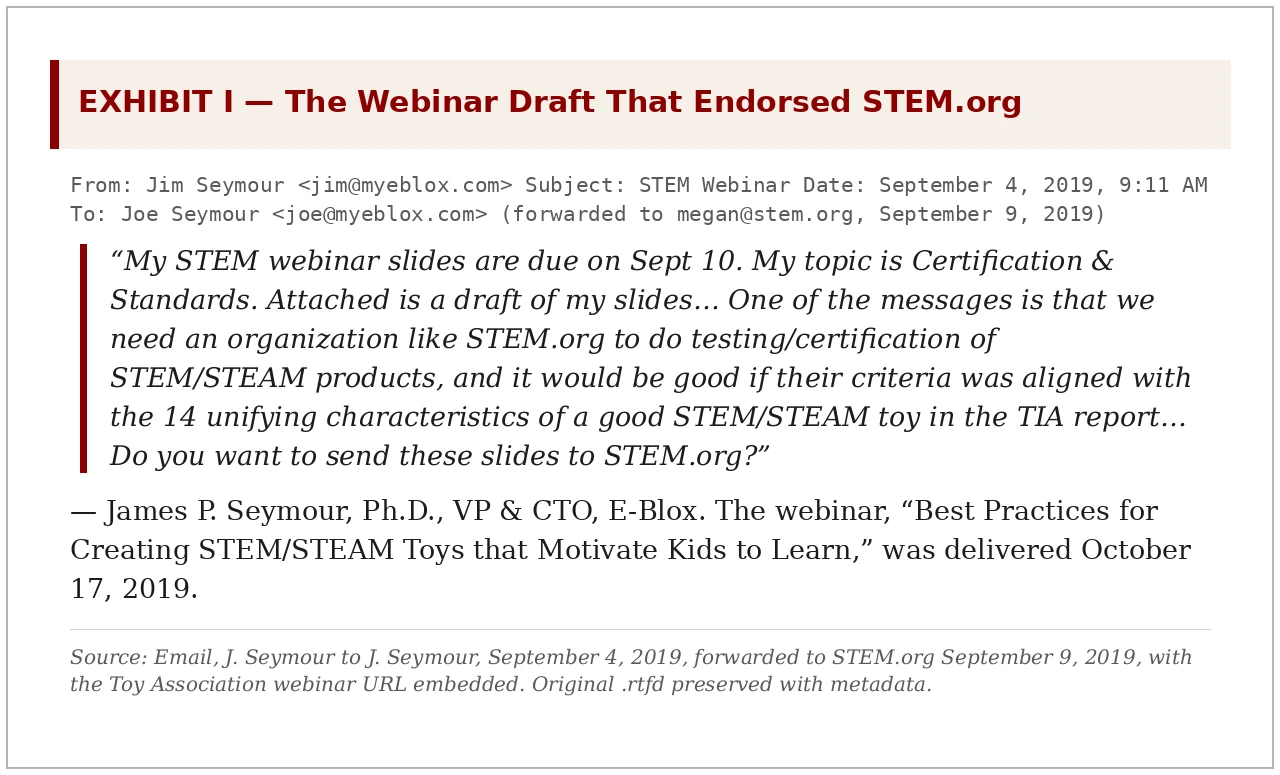
What the delivered webinar actually said on October 17 is a matter of record — the Association published it — and a side-by-side of the September draft against the October broadcast tells the rest. The STEM.org material was gone. The Seymours informed me at the time that they had been asked by Janis Zegman, the Association’s Senior Manager of Marketing Projects, to remove it from the presentation. My understanding then, and now, is that the reason involved the Association’s plans for a credential of its own.
The Call, November 8, 2019
On the afternoon of November 8, 2019 — National STEM Day — Steve Pasierb, President of the Toy Association, called me directly. I was visiting toy companies in the Chicago area. He spoke of collaboration.
I made him a concrete offer — the same one I had been signaling for eighteen months. I proposed a revenue structure for joint product validation: twenty-five percent to the Toy Association, twenty-five percent to STEM.org, and fifty percent to the Toy Association Foundation — the Association’s own charitable arm, which solicited donations from us annually. I offered the use of the domain names we held, including STEM.toys, STEM.games, and others in our credentialing portfolio. He said it sounded good. He said he would call back within two weeks.
Before we hung up, I asked Steve directly whether the Association was working on a competing mark of its own, and he denied it. Yet the evidence I had already received, before that call, indicated the decisions had been made. The denial and the documented record did not line up — and the record was not mine to rewrite.
That follow-up call never came. No call, no email, no letter — then or ever. Mr. Pasierb is welcome to share his own recollection.
The arithmetic of my offer deserves a moment. Under it, the Toy Association and its foundation would have kept seventy-five cents of every validation dollar; STEM.org — the original, established evaluator that built the standard — would have kept twenty-five. Read that again. I was the one offering to take the smaller share — a quarter — and hand three-quarters to the organization across the table.
The Launch, August 2, 2021
On August 2, 2021, the Toy Association announced its own program: a “STEAM Accreditation,” offering manufacturers a “Stamp of Approval” for packaging and marketing, administered with an overseas partner — at rates several times what STEM.org had ever charged.
Note the two words they chose — and the two they avoided.
They did not call it STEM Approved. We held that ground: the registrations, the domains, the settlement, the community vote. They did not call it STEM Authenticated. We had used that mark in commerce for years, with our retail partners printing it on product pages. So they reached for the adjacent letter and the grander noun: STEAM, and Accredited — close enough to harvest the recognition a decade of our work had built into the category, distinct enough to keep the lawyers comfortable.
But “accreditation” is not a synonym for prestige. It is a term with a meaning. Accreditation is what a recognized authority does to an institution or program — an ongoing, revocable certification of capacity. A university is accredited. A hospital is accredited. A toy is not accredited, for the same reason a Chanel bag is not accredited and a Babe Ruth signature is not accredited. An object embodying a claim is authenticated: examined against evidence to determine whether the claim made about it is true. I published this distinction in 2023, and it has governed our nomenclature since the first issuance of each mark: products are authenticated; schools and programs are accredited. The misnomer is not pedantry. It borrows the costume of institutional oversight and drapes it over what is, mechanically, a product award with a fee attached.
And the timeline now reads, end to end, in documents: research contributed through the Association’s own consultant (2018) → credentials and references delivered to Seiter and the President (June 2018) → a published framework with our benchmarks and a thank-you but no citation (May 2019) → a certification webinar drafted to endorse us, delivered without us (October 2019) → a presidential phone call promising collaboration, followed by silence (November 2019) → a competing mark, named one letter away from ours (August 2021).
The Best Case for the Other Side
Fairness requires the strongest version of the opposing argument, so here it is. The Toy Association would say: a trade body convening its members around a public assessment framework is standard-setting, not capture. Its evaluation partner brings genuine child-development credentials and observed-play methodology. An industry defining quality for itself is better than no definition. “STEAM” was an honest evolution — the arts plainly belong in creative play. And the Formula for Success report drew on sixty-seven member surveys, twenty-six interviews, and two expert panels; no single contributor owns a synthesis.
These are not absurd claims, and the observed-play methodology deserves genuine respect.
But even the strongest version of that case concedes the central point. A trade association exists to advance its members’ commercial interests. Its revenue is membership dues, trade-show booths, sponsorships, and advertising from the very manufacturers whose products its seal now “accredits”. When the body that profits from a product category also administers the mark that validates the category, the conflict is not a flaw in execution — it is the organizing principle. The question is never whether the evaluators are sincere. It is what happens, structurally, on the day an honest finding and a paying member’s interest point in opposite directions.
The Aftermath, 2023
In July 2023, Fast Company ran an article on “STEM-washing” — the practice of slapping STEM language on products with no educational substance — which presented the Toy Association’s program as the industry’s only answer, with no mention of STEM.org Educational Research that had been performing exactly that function years before it.
I wrote to the reporter, Nate Berg, on July 13, 2023, laid out the history, and asked directly whether the article was part of an advertorial relationship between the publication and the Toy Association, or whether he was accepting comment.
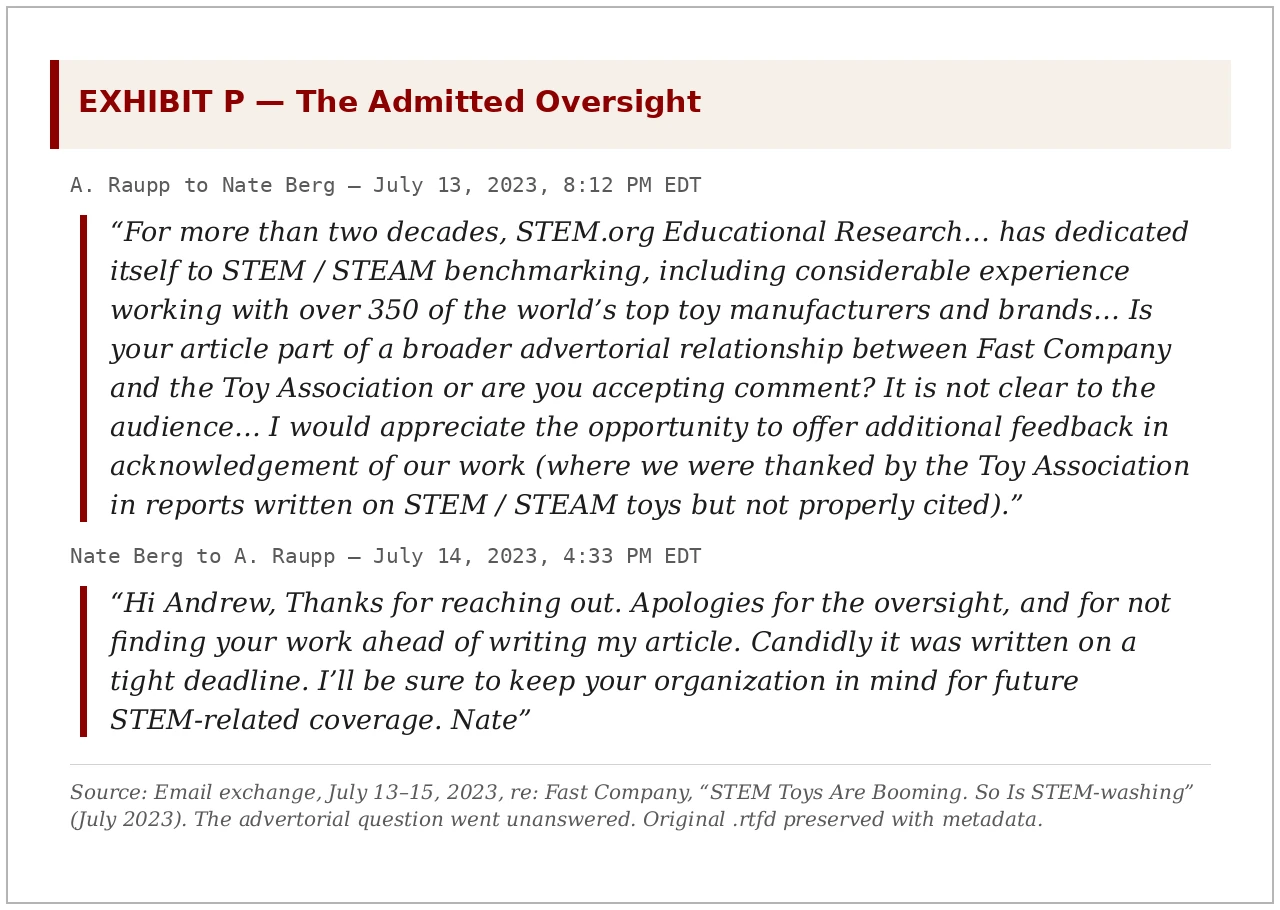
I take Mr. Berg at his word, and I credit him the apology — it is more than the Association has ever offered. But sit with what the exchange establishes. A professional journalist, based in our own region, writing specifically about the problem of unverifiable STEM claims, could not find a decade of prior art that a single search would have surfaced — because by 2023, the public record had been so thoroughly written around us that even the diligent couldn’t see the foundation. The advertorial question, for what it is worth, went unanswered. An omission was admitted. The narrative it served was already in print.
That is how erasure actually works. Not a conspiracy — a current. One unciting report, one rewritten webinar, one unreturned call, one deadline-rushed article at a time, until the record reads as though the founders never existed and the institution arrived first.
The Economics of Integrity
Here is the part of this story the seal-economy framing predicts least: product authentication loses us money, and we run it anyway.
STEM.org charges a flat $303.85 USD annual fee, covering up to ten product evaluations per quarter— roughly eight dollars per product, the same for a garage startup as for a multinational. There is one further condition, and it is the inverse of every pay-to-play model in existence: a manufacturer pays only if the product passes. If it fails our rubric, the fee is refunded in full. We earn a fee only when a product genuinely passes — and at our prices, that fee rarely covers the work behind it. The hours of rubric review, manufacturer feedback, and credentialing routinely exceed it. Product authentication is, frankly, a loss leader.
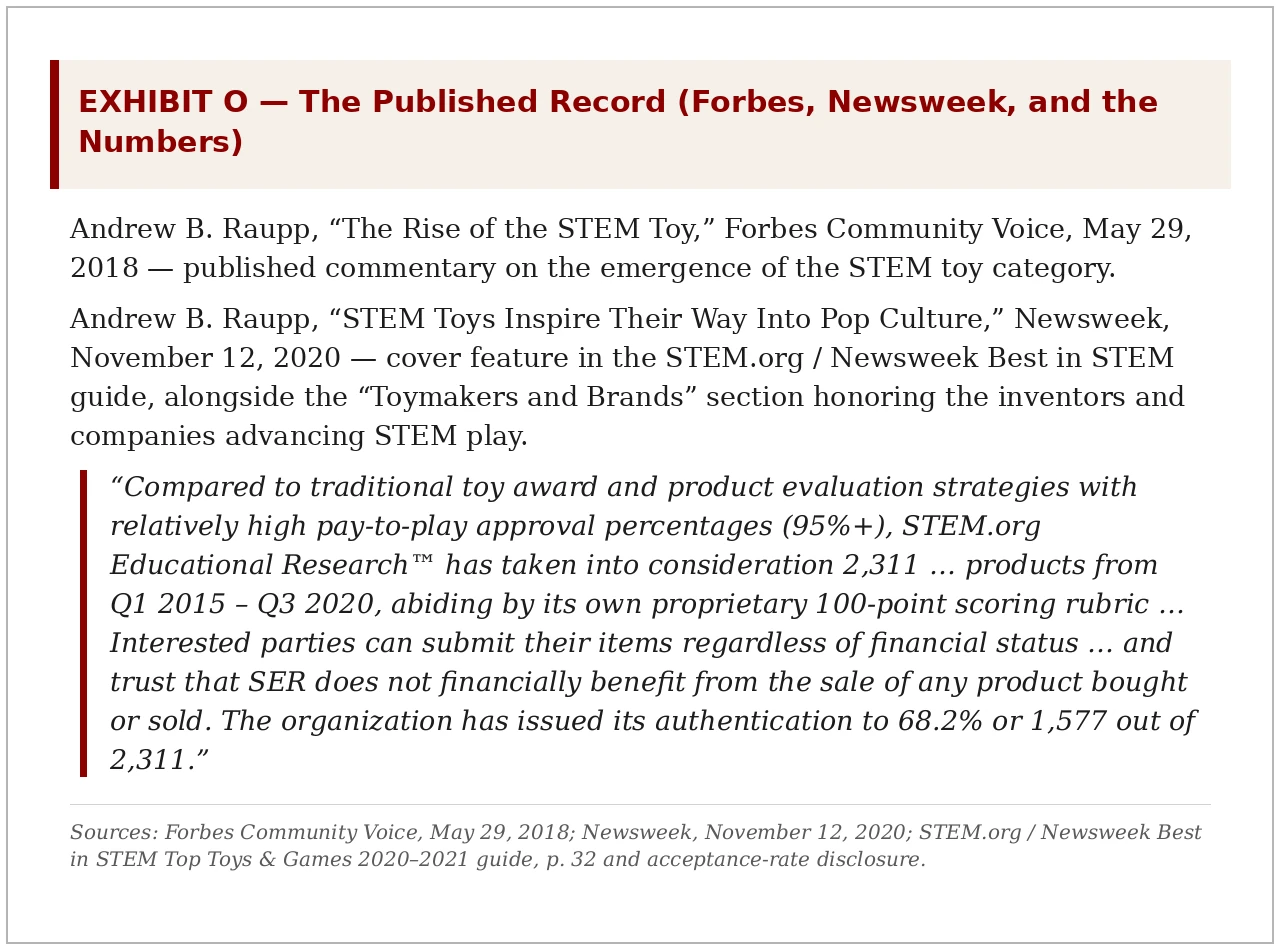
And we often say no. In the Best in STEM guide we published with Newsweek in 2020, we disclosed the figures: against traditional toy-award programs whose approval rates run north of ninety-five percent, STEM.org evaluated 2,311 STEM-designated products from the first quarter of 2015 through the third quarter of 2020 and authenticated 1,577 of them — 68.2 percent. Nearly a third did not pass. That rejection rate has been a matter of public record for years.
Our organization sustains itself elsewhere: teacher credentials and training, STEM school and camp accreditation, curriculum review — the full ecosystem, of which toys are one room. We validate products because parents, teachers, and retailers deserve to know whether a box does what it claims, not because seals are a business. We do not sell toys, take affiliate revenue, or accept advertising from the manufacturers we evaluate. And every credential we issue is written to a public blockchain, where our findings — and our mistakes — are permanent, timestamped, and beyond our own power to quietly revise.
Now run the trade-association model through the same three questions, and the contrast is total. We do not weigh this work by what it earns. The other sells accreditation to the same manufacturers who buy its ad space, its sponsorships, and its trade show tables — a clear conflict of interest.
Stewardship
This account has weighed on me for years, and I am publishing it now, in our twenty-fifth anniversary year, for a simple reason: the history of the STEM toy movement belongs to the community that built it — the manufacturers who submitted their products to honest scrutiny, the parents who learned to look for a mark that means something, the educators whose standards we encoded — and that history was being rewritten while we worked.
So let the record state what the documents support: Beginning in 2014, the toy industry came to us asking what “STEM” meant on a box. We answered with a rubric, a protocol, and a trustmark. We then defended that language in a legal proceeding, put the nomenclature to the community, contributed our research when the trade association asked, offered our domains, and proposed a revenue split weighted three-to-one in their favor — all while volunteering our time and money to the organization that took advantage of the situation and sought to profit from an international movement.
They answered with a thank-you in an appendix, a webinar edited around us, a mark named one letter away from ours, and a public story that wrote us out entirely.
I am not asking the toy community to boycott anyone. I am not asking for an apology, though the record would support one. I am asking toymakers, retailers, and parents to do the one thing every genuine STEM education ultimately teaches: examine the evidence, question the institution, and decide for yourself.
We formalized this work when nobody else wanted it. We kept it affordable when it could have been a toll booth. We carry the cost when a product doesn’t pass, publish the standards, and seal every finding where it cannot be unwritten — ours included.
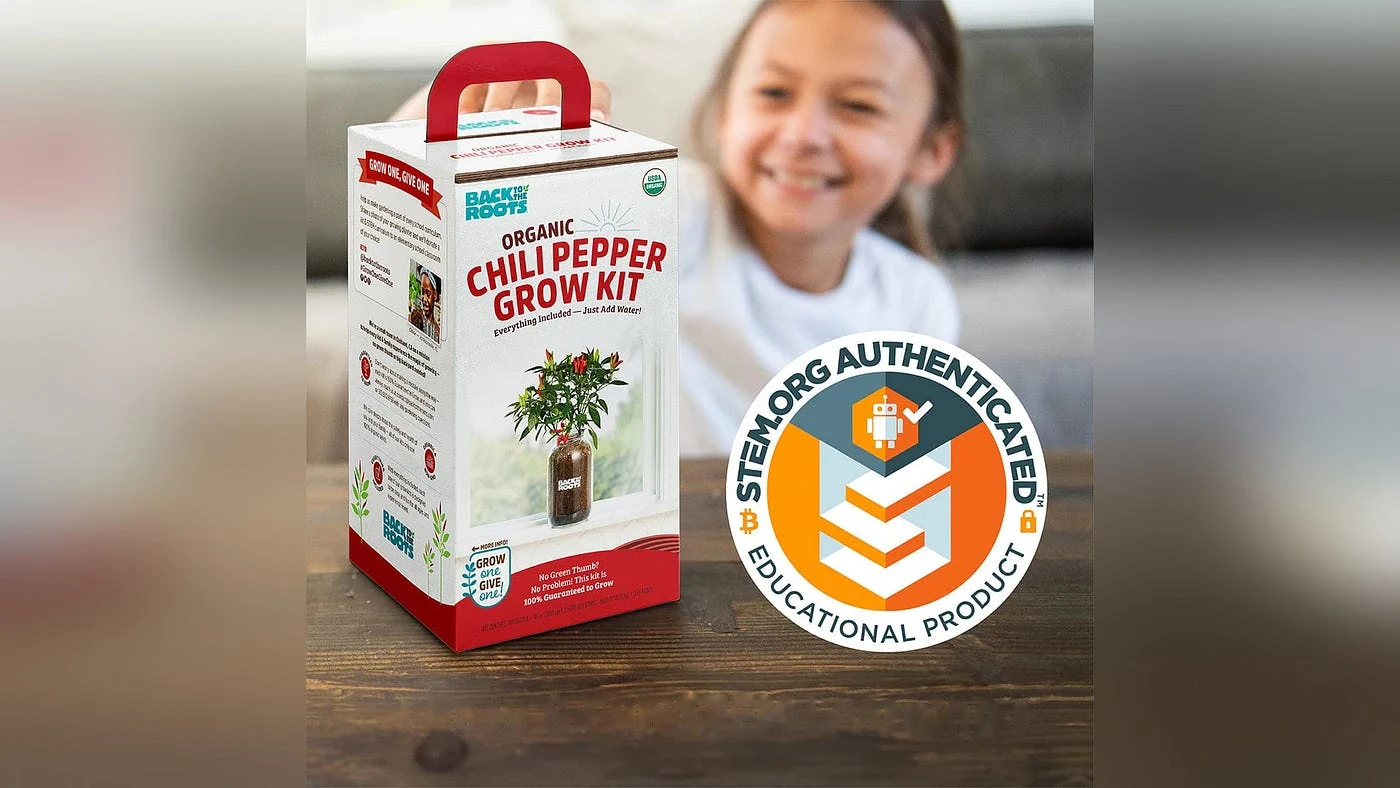
I did not write this to settle a score. I wrote it so the record would survive — so that those who built this movement cannot be quietly written out of their own history. It is permanent now, it is documented, and I am prepared to fiercely defend every line of it.
Disclaimer: The views and opinions expressed in this article are those of the author, written in the author’s individual capacity. They do not represent the official position of any institution, employer, client, partner, or affiliated organization, and should not be attributed to any such entity. This piece is provided for general informational and educational purposes only. It does not constitute legal, financial, investment, regulatory, or professional advice of any kind.
Any references to identifiable organizations, institutions, public figures, or initiatives are offered in good faith as fair comment and critical analysis on matters of legitimate public interest. Such references reflect the author’s honest opinion and interpretation of publicly available information; they are not assertions of verified fact and are not intended to defame, disparage, or misrepresent any party. All trademarks, names, and marks remain the property of their respective owners, and their mention implies no affiliation, sponsorship, or endorsement. Forward-looking statements reflect the author’s views as of the date of publication and are subject to change without notice.
All content is provided “as is,” without warranties of any kind, express or implied. To the fullest extent permitted by law, the author and publisher disclaim any and all liability for any loss, damage, claim, or adverse consequence — direct or indirect, foreseeable or otherwise — arising from any reliance upon, or action or inaction taken on the basis of, the contents herein, and assume no duty to update or correct any information following publication. Any quoted material is used in limited form for purposes of commentary, criticism, and education consistent with fair-use, journalistic principles.
Andrew B. Raupp is the Founder / Executive Director @stemdotorg. “Resolutely preserving the rights and freedoms of the STEM education community through sound policy & practice… Credentialed member of the International Federation of Journalists and National Writers Union”
Keywords
First published June 17, 2026. Original publication