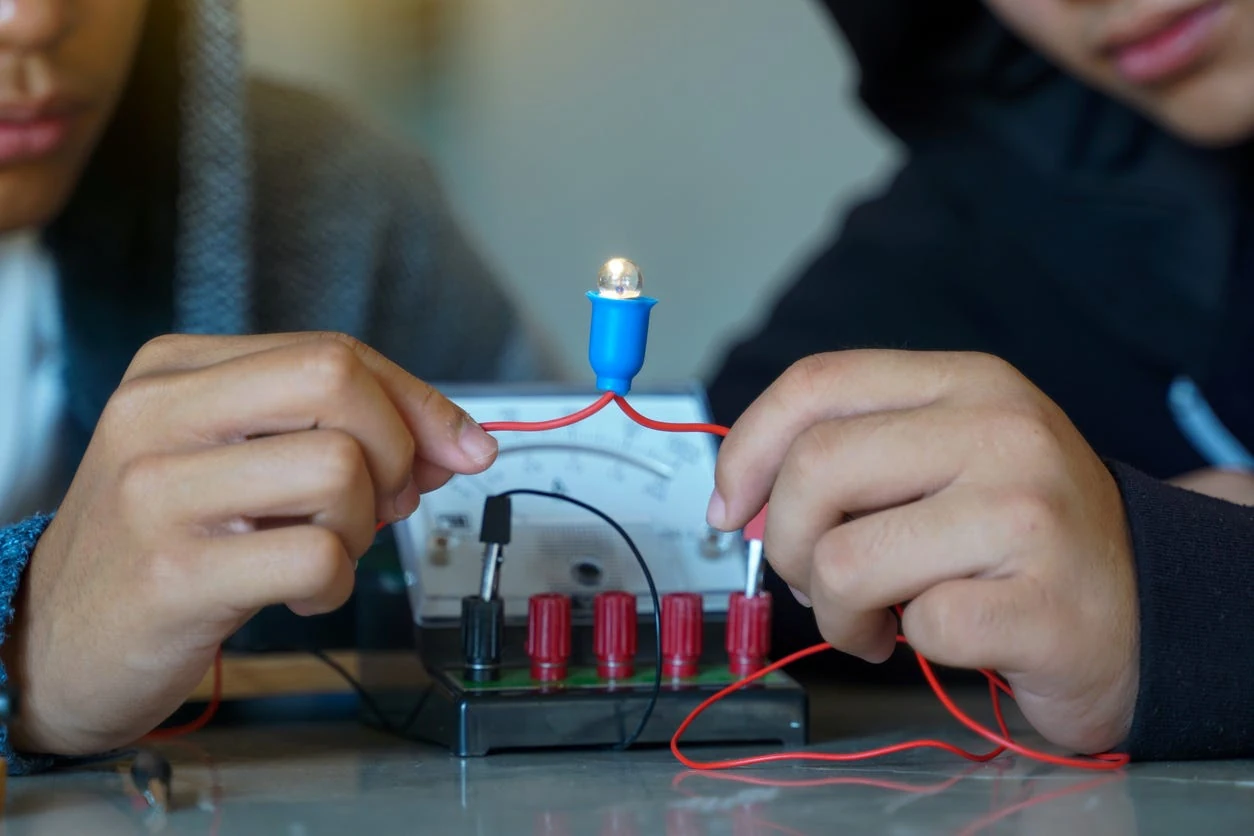
When the Lights Flicker: How STEM Education Organizations Can Prepare for Uncertainty
On resilience, foresight, and institutional endurance in unsettled times
In this essay +
- Uncertainty Is Not an Event — It Is the Environment
- From Abstract Value to Real Value
- Mobility as a Strategic Asset
- Capital in Times of Fatigue
- Debt and the Illusion of Continuity
- The Material Reality of STEM
- Efficiency Without Sentimentality
- Reinvestment as Discipline, Not Aspiration
- Final Thoughts: Preparing Without Predicting

Authors Note: There are moments in history when the ground does not collapse beneath our feet, but subtly shifts — quietly enough that many mistake the movement for imagination. Institutions continue to operate, payroll clears, meetings convene, and optimism remains publicly intact. Yet beneath this surface calm, the assumptions that once governed stability begin to erode. Credit grows selective. Costs inch upward without apology. Supply chains stretch thin. The future, once treated as an extension of the present, becomes opaque. It is in these moments — before panic, before headlines — that serious organizations must think most clearly.
This analysis is not financial advice. It is a sober observation of uncertainty as a permanent condition rather than a temporary deviation. For STEM education organizations — often mission-driven, resource-conscious, and structurally lean — the coming era will reward preparation over prediction, resilience over expansion, and independence over convenience. Those who endure will not be those who guessed correctly, but those who built margin into every assumption.
Uncertainty Is Not an Event — It Is the Environment
The great error of modern organizational planning is the belief that disruption arrives as an exception. History suggests the opposite. Stability is episodic; uncertainty is continuous. Wars, pandemics, monetary shifts, technological upheavals, and political realignments do not arrive singly, nor do they politely wait their turn. They overlap, compound, and amplify one another.
For STEM education organizations, whose work depends on materials, mobility, trust, and continuity, uncertainty demands a different posture altogether. The question is no longer, “What will happen next? but rather, What can we withstand regardless of what happens next?”
Survival, in such conditions, is not a matter of foresight. It is a matter of design.
From Abstract Value to Real Value
Modern institutions are accustomed to abstractions: balances held in accounts, receivables promised by third parties, and assets whose value exists primarily as an entry in a system. These abstractions function well — until they don’t. Periods of uncertainty tend to expose the fragility of value that depends entirely on uninterrupted systems of trust, clearing, and enforcement.
Organizations that persist through turbulence are those that quietly convert a portion of their abstract value into real value — assets that exist independently of sentiment, software, or solvency assurances. Historically, tangible assets have served this role precisely because they are indifferent to narratives. They do not require confidence to function.
Can We Afford CBDCs at the Expense of STEM Education?
This does not imply abandoning modern systems. It implies balance. A portion of reserves held in forms that cannot be diluted by policy decisions, delayed by intermediaries, or rendered inaccessible by system stress is not an act of alarm — it is an act of prudence.
Likewise, openness to multiple forms of lawful payment — traditional, alternative, physical, and digital — is not ideological flexibility. It is operational resilience. In uncertain times, adaptability becomes liquidity.
Mobility as a Strategic Asset
Uncertainty compresses time. Decisions that once unfolded over years are forced into months or weeks. Geography, once assumed stable, can become a constraint overnight. Organizations that bind their identity too tightly to a single place, platform, or modality often discover — too late — that continuity requires movement.
STEM education organizations should regard mobility as a strategic asset. Programs must be designed to operate across environments. Instruction should function both online and offline. Credentialing, verification, and communication systems must remain operational even when infrastructure is strained.
This is not merely a technological concern. Leadership itself must be portable. Governance structures, documentation, and institutional knowledge should never reside exclusively in one building, one jurisdiction, or one individual. The organization must be capable of reconstituting itself wherever conditions permit.
The future will favor institutions that can move without losing themselves.
Capital in Times of Fatigue
Periods of uncertainty create fatigue, and fatigue attracts capital of a particular kind. Offers arrive framed as relief — partnerships, investments, consolidations, or “support for small organizations.” Often, these overtures originate not from peers, but from intermediaries whose scale and incentives remain carefully obscured.
Such capital rarely seeks to preserve mission. It seeks to acquire position.
STEM education organizations must learn to interrogate assistance with the same rigor they apply to curriculum. Who stands behind the offer? What interests are represented indirectly? What control is exchanged for short-term comfort? Transparency is not impolite; it is essential.
Many organizations are not destroyed by competition, but by rescue.
Debt and the Illusion of Continuity
Debt has a peculiar quality in uncertain times: it feels stabilizing precisely when it is most dangerous. Access to credit can mask structural weakness, postpone necessary reform, and create the illusion that tomorrow will resemble yesterday closely enough to refinance today’s obligations.
History offers a harsher lesson. Credit tightens suddenly, often in response to forces entirely external to the borrower. Organizations that rely on rolling debt forward find themselves exposed at the exact moment flexibility is most needed.
A disciplined limit on leverage — no more than a modest fraction of annual income — should be treated as a guardrail, not a suggestion. Exceptions may exist, but they should be rare, explicit, and temporary. Debt should serve the organization; it should never define it.
Just as importantly, organizations should abandon the assumption that future loans will be available. In periods of systemic strain, liquidity disappears unevenly and without warning.
The Material Reality of STEM
STEM education is inseparable from the physical world. Tools, components, instruments, and devices form the backbone of instruction and innovation. These materials are not immune to uncertainty. They are among its first casualties.
As currencies weaken and trade relationships strain, the cost of goods rises — not episodically, but structurally. Components containing precious metals, specialized alloys, or complex manufacturing inputs will grow more expensive and less predictable in supply. Delays become routine. Substitutions become inferior.
Organizations must respond with foresight rather than improvisation. Reliable suppliers should be cultivated deliberately. Essential materials should be inventoried, protected, and insured. Emergency reserves are not hoarding; they are continuity planning.
Preparation here is not speculative. It is operational.
Efficiency Without Sentimentality
Uncertainty has little patience for inefficiency. Organizations often fall not because their mission lacks merit, but because internal structures absorb more energy than they produce. One of the most persistent failures in small and medium-sized institutions is the substitution of loyalty for performance.
Why Entrepreneurs Don’t Scale — John Hamm (PDF)
Commitment matters. Character matters. But roles must justify their existence through contribution, not history. When inefficiency is tolerated out of sentiment, the burden shifts to those still producing value — until exhaustion follows.
Clear expectations, measurable outcomes, and honest evaluation are acts of respect. They preserve the institution so that the mission may continue beyond the present moment.
Reinvestment as Discipline, Not Aspiration
Uncertain times punish improvisation and reward discipline. A clear reinvestment framework provides ballast when conditions shift.
A portion of surplus — often between a quarter and half, depending on phase — should be returned directly to strengthening the organization itself. Another portion should be preserved in assets that resist erosion. Compensation should remain fair, sustainable, and transparent. The remainder should reinforce infrastructure: systems, materials, and capabilities that expand resilience rather than fragility.
This is not austerity. It is stewardship under constraint.
Final Thoughts: Preparing Without Predicting
The future rarely conforms to schedules or forecasts. It advances in fragments — through market shifts, policy changes, technological strain, and human fatigue — revealing strength and weakness not all at once, but in succession. For STEM education organizations, whose credibility rests on disciplined thinking and applied problem-solving, this moment demands a clear-eyed reassessment of how institutions themselves are built, funded, and sustained.
Preparation is not an act of pessimism, nor is it a concession to collapse. It is an acknowledgment that uncertainty is structural, not episodic. Systems will strain. Costs will rise. Access will narrow. Organizations that assume continuity without reinforcement place their mission at the mercy of forces beyond their control. Those that plan deliberately regain agency.
This is the important work of stewardship — strengthening foundations before they are tested, building margin where none is demanded, and choosing independence over convenience long before circumstances force the choice. It is the discipline of reinvesting wisely, of resisting predatory capital, of valuing efficiency over sentiment, and of safeguarding people, purpose, and assets with equal seriousness. These decisions rarely earn applause. They are noticed only when they are absent.

When the lights flicker — and they will — the organizations that endure will not be those that issued the boldest predictions or chased the loudest assurances. They will be the ones that prepared deliberately, moved prudently, and built with patience rather than illusion. In that moment, resilience will speak for itself. And those institutions will stand not merely as survivors of uncertainty, but as proof that wisdom, diligently applied, remains the most powerful form of leadership.
Andrew B. Raupp is the Founder / Executive Director @stemdotorg. “Resolutely preserving the rights and freedoms of the STEM education community through sound policy & practice…”
Keywords
First published January 29, 2026. Original publication