Blades Against the Machine: Britain’s Underground Resistance
Inside the masked movement cutting down London’s climate cameras—and the debate over liberty, law, and control
In this essay
- Prologue: The Night Watchers
- The Age of Invisible Eyes
- The Spark of Resistance
- Symbols Over Steel
- Climate as the New Pretext
- Criminals in the Dock, Heroes in the Pub
- The Ethics of Nonviolent Sabotage
- Britain’s Tradition of Defiance
- The Politics of Visibility
- The Battle for Britain’s Future
- Epilogue: Sparks of Freedom
Prologue: The Night Watchers
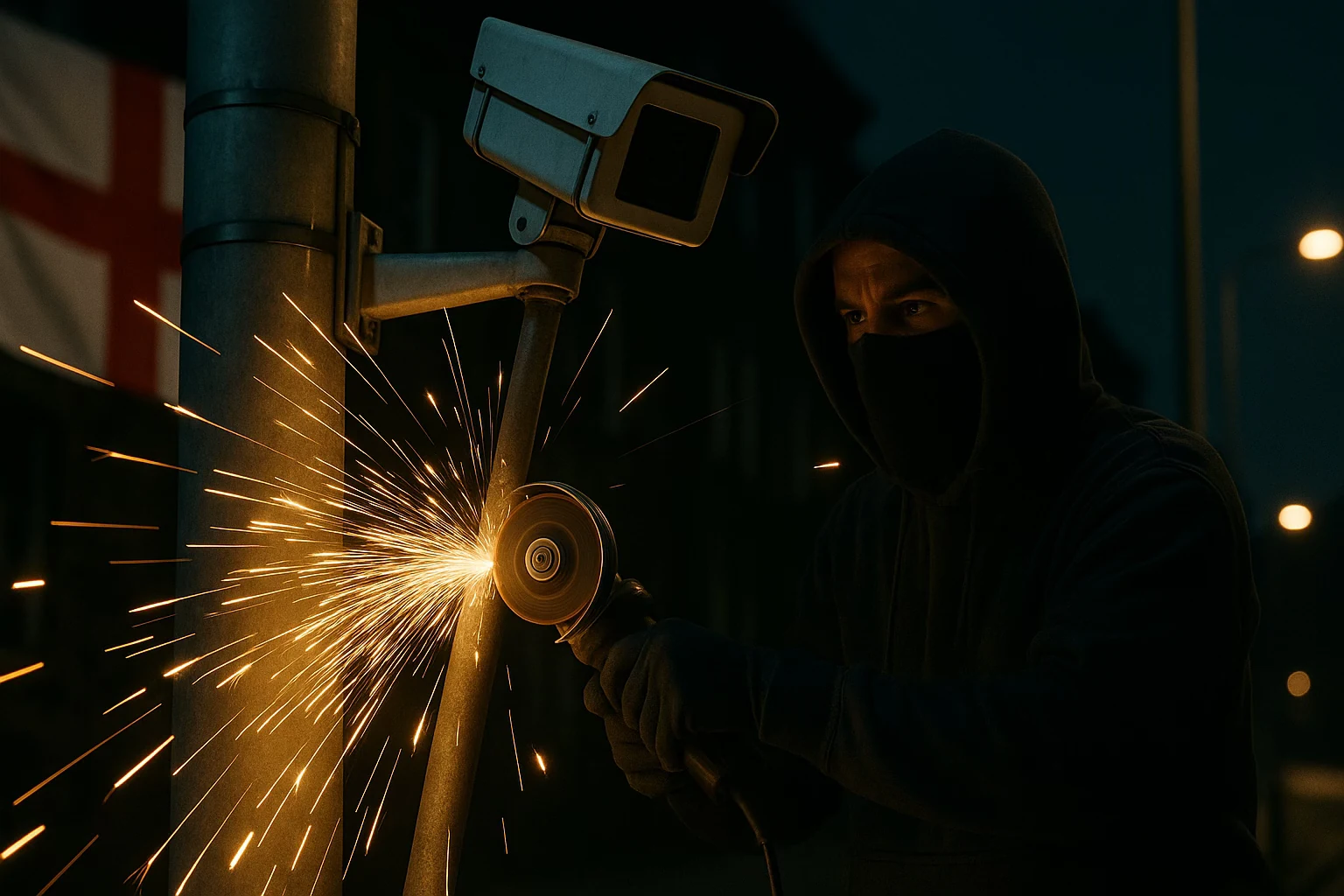
Under the muted glow of a South London streetlamp, two masked figures move swiftly and deliberately. One produces a cordless angle grinder, its disc screeching to life. Sparks shower the asphalt like fleeting fireworks, briefly illuminating the outline of the Ultra Low Emission Zone (ULEZ) camera above them. Within moments, the pole buckles. The silent sentinel topples.
Per Transport For London:
“To help clear London's air, the Ultra Low Emission Zone (ULEZ) operates 24 hours a day, 7 days a week, every day of the year, except Christmas Day (25 December). The zone operates across all London boroughs, and does not include the M25.
If your vehicle doesn't meet the ULEZ emissions standards and isn't exempt, you need to pay a £12.50 daily charge to drive within the zone. This applies to cars, motorcycles, vans and specialist vehicles (up to and including 3.5 tonnes) and minibuses (up to and including 5 tonnes).
Lorries, vans or specialist heavy vehicles (all over 3.5 tonnes) and buses, minibuses and coaches (all over 5 tonnes) do not need to pay the ULEZ charge. They will need to pay the LEZ charge if they do not meet the Low Emission Zone (LEZ) emissions standard.
Owners of non-UK registered vehicles also need to meet the ULEZ emissions standards or pay the daily charge to drive within the zone. Vehicles need to be registered with us, even if they meet the emissions standards.”
There are no chants, no placards, no fists raised in the air. Only the quiet precision of an act that has become as symbolic as it is subversive. These are Britain’s Blade Runners—an informal network of citizens who, under the cover of darkness, cut down the expanding infrastructure of surveillance installed in the name of climate control.
To the authorities, they are criminals, vigilantes, and saboteurs. To a growing number of ordinary Britons, they are heroes—nonviolent defenders resisting what they see as the encroachment of a technocratic order, one camera at a time.
The Age of Invisible Eyes
Few countries have embraced surveillance as completely as the United Kingdom. London alone is estimated to host nearly a million closed-circuit cameras, giving it one of the highest densities of surveillance per capita in the world. From public buses to lampposts, the quiet hum of observation has become a fact of life.
The introduction of the Ultra Low Emission Zone in 2019 added another layer. Designed to discourage high-pollution vehicles, the scheme relies on an expansive network of cameras with automatic number-plate recognition. These systems operate 24/7, cross-referencing license plates against databases to determine whether drivers must pay daily charges or face fines.
By 2022, the ULEZ generated an estimated £224 million in revenue for Transport for London. Expansion to Greater London in August 2023 extended coverage to nearly nine million residents, meaning that even brief journeys to school, work, or hospital could fall under its gaze.
Officials heralded the move as a moral imperative, citing tens of thousands of premature deaths linked to air pollution. But for critics, the program represented the latest step in a steady march toward comprehensive surveillance—where environmental policy doubles as enforcement infrastructure.
The Spark of Resistance
As the cameras multiplied, so too did resentment. The Blade Runners emerged as an answer.
Their actions first caught public attention in early 2023, when reports surfaced of vandalized and stolen ULEZ cameras. By that summer, the Metropolitan Police acknowledged hundreds of incidents. Between April and mid-August alone, more than 300 cameras were disabled.
By May 2024, independent researchers estimated that 4,500 cameras had been vandalized across London, some boroughs seeing more than half their devices rendered inoperable. Replacement costs were estimated in the tens of millions.
Yet the movement remained elusive. There was no headquarters, no hierarchy. Instead, small groups—or sometimes lone actors—operated autonomously. They cut wires, sprayed paint over lenses, or toppled entire poles with saws. Social media accounts sympathetic to their cause, such as the pseudonymous Matt Hardy, posted videos of nighttime raids, cementing their status as folk heroes.
“I’ve taken down 34 cameras,” one anonymous activist told the Evening Standard. “We are going to take down every single one no matter what”.
Symbols Over Steel
Unlike violent insurgents, the Blade Runners target infrastructure, not people. Their sabotage is highly symbolic: the dismantling of devices that, in their eyes, embody state overreach.
To their supporters, this places them in a long tradition of nonviolent resistance. When American colonists dumped taxed tea into Boston Harbor in 1773, they destroyed property, not lives. Gandhi’s 1930 Salt March was a direct violation of colonial law, designed to fracture its legitimacy. Polish dockworkers in the 1980s staged strikes that paralyzed an authoritarian regime.
The Blade Runners’ tools are not rifles but grinders. Their protests leave no blood, only sparks.
Climate as the New Pretext
The conflict reveals a deeper question: when does environmental policy cross into political control?
The Club of Rome’s 1972 report Limits to Growth argued that unchecked economic expansion would exhaust planetary resources. Since then, sustainability has become a global policy framework, echoed in the UN’s Agenda 2030 and Paris Agreement commitments.
But critics warn that noble goals can mask coercive tools. A recent Spiked essay described London’s ULEZ not as an environmental initiative but as “a class war dressed in green”—penalizing working-class drivers while sparing elites.
Alternative outlets like OffGuardian argue that climate rhetoric has been weaponized to normalize digital surveillance, paving the way for carbon rationing, “15-minute cities,” and restrictions on personal freedom.
The Blade Runners embody this skepticism. To them, every camera is not just a pollution monitor but a node in a growing web of control.
Criminals in the Dock, Heroes in the Pub
Authorities have responded with a mix of condemnation and crackdown. The Metropolitan Police launched Operation Eremon in mid-2023, deploying armored vehicles to protect contractors installing new cameras. Several suspects have been arrested and charged with criminal damage.
Mayor Sadiq Khan has denounced the Blade Runners as selfish vandals endangering public health.
Yet in pubs, markets, and online forums, admiration simmers. “I understand why people are cutting it down,” one Londoner wrote on Reddit. “These cameras are just another way to extract money from people.”
Opinion polls show broad disapproval of ULEZ expansion, particularly in outer boroughs where public transport is sparse and car travel unavoidable. The backlash has already reshaped national politics, with opposition leaders pledging to revisit or roll back enforcement.
The Blade Runners’ heroism, in the eyes of many, lies not in destruction but in defiance.
The Ethics of Nonviolent Sabotage
The movement raises a moral dilemma: can targeted property damage, absent violence against persons, be a legitimate form of civil resistance?
Philosopher Hannah Arendt argued that civil disobedience becomes necessary when laws no longer reflect the consent of the governed. Isaiah Berlin warned that liberty erodes not in sudden blows but in “the slow attrition of freedom.” And Václav Havel, chronicling resistance under communism, insisted that living “within the truth” sometimes requires violating unjust norms.
By these measures, the Blade Runners are not anarchists but dissenters—people who accept personal risk to defend a principle. Their sabotage is nonlethal, symbolic, and targeted. Their message: laws imposed without consent forfeit their moral claim to obedience.
Britain’s Tradition of Defiance
Britain’s history is not only one of empire and order, but also of resistance to overreach—a legacy of defiance that has shaped the very idea of liberty in the modern world.
In 1215, at Runnymede, rebellious barons forced King John to sign the Magna Carta, a radical assertion that even monarchs were bound by law. It was the first great codification that power must answer to the people—a seed from which constitutional government grew.
Centuries later, across the Atlantic, the American Founders drew deeply from this British inheritance. Their Declaration of Independence and Bill of Rights were children of the Magna Carta, sharpened by Enlightenment philosophy. They cast off a distant crown not out of hatred for Britain, but in fidelity to Britain’s highest tradition: that free men do not submit silently to unjust rule.
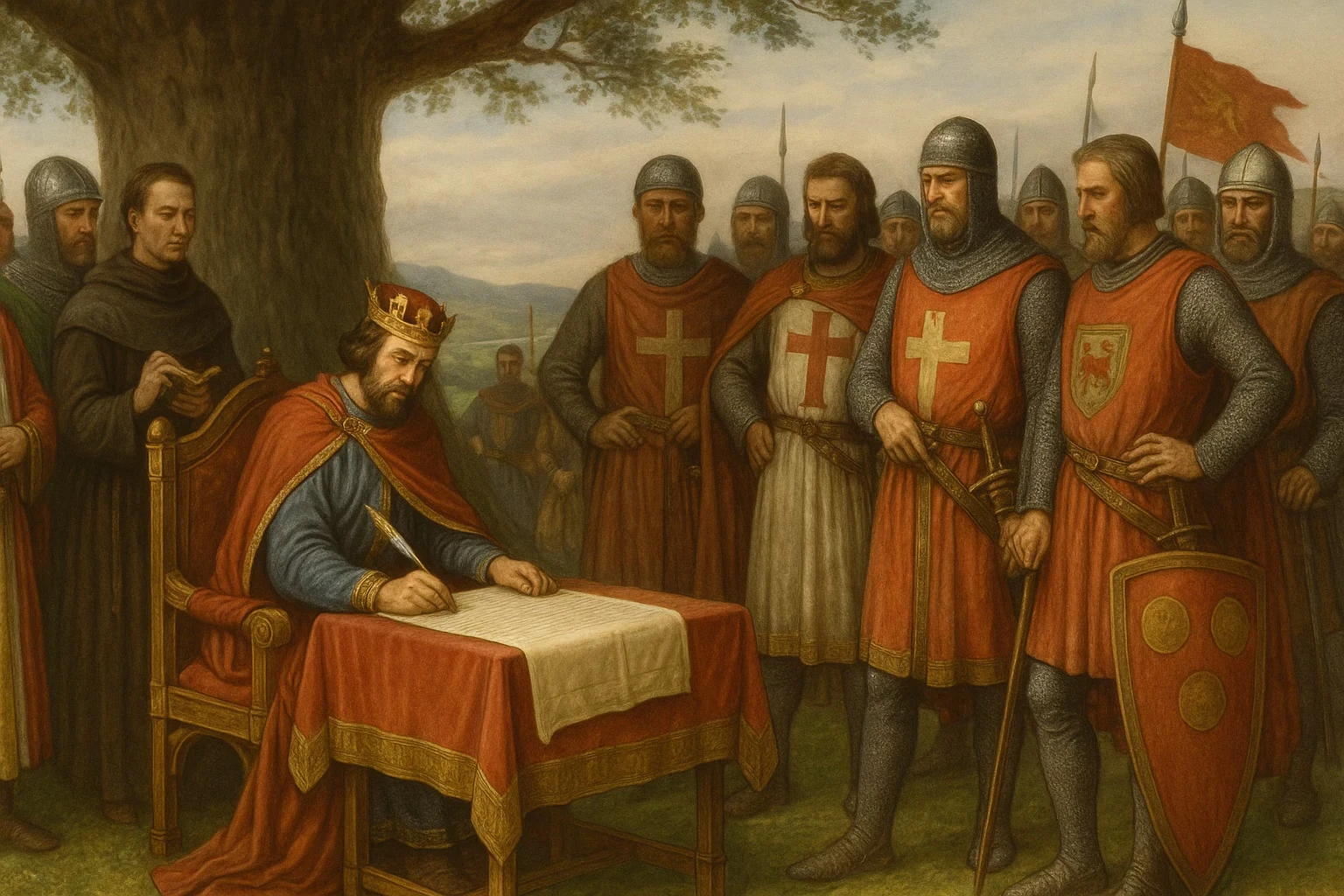
From the barons of Runnymede to the patriots of Philadelphia, history teaches that authority—when it ceases to respect consent—must be challenged. What was once branded treasonous became, in time, the very foundation of liberty.
The Blade Runners see themselves in this lineage. They are not vandals, but heirs of a tradition that stretches from Magna Carta through the American Revolution: ordinary citizens compelled to act when institutions close their ears to the governed. Just as the Founders resisted taxation without representation, the Blade Runners resist surveillance without consent.
In toppling cameras, they invoke the same principle that animated Runnymede and Philadelphia alike—that no government, however well-intentioned its rhetoric, has the right to bind free men in chains of silence.
The Politics of Visibility
Surveillance thrives because it hides in plain sight. Cameras dissolve into lampposts, fines slip quietly through the post, and control becomes seamless—bureaucratic, silent, unquestioned. Its greatest strength is not force but normalization: what once seemed intrusive becomes part of the everyday landscape.
Resistance, by contrast, must refuse invisibility. Jacques Ellul, in his writings on technological society, warned that modern systems entrench themselves by appearing both neutral and inevitable. When no one challenges them, they seem as natural as gravity, beyond dispute or escape.
By cutting down cameras, the Blade Runners break that illusion. Sparks in the night transform into a visible language of dissent, a reminder that what has been built can also be unbuilt. Each toppled pole is not just a disruption of steel and circuitry—it is a rhetorical act, forcing the public to confront what had been quietly normalized.
In this sense, their defiance restores what Ellul recognized as essential: the spectacle of resistance. A single act of disruption punctures the myth of inevitability, proving that no system—however pervasive, however entrenched—is beyond the reach of free men determined to resist.
The Battle for Britain’s Future
What hangs in the balance is not a fee for driving into town. It is nothing less than the meaning of freedom in the 21st century.
The question is stark: do Britons consent to be tracked, tallied, and fined by machines hidden in lampposts—all under the banner of climate virtue? Or will they insist that environmental necessity must never be used as a pretext to strip away democratic consent?
For once surveillance is normalized, can it ever be undone? History suggests not. Chains, once fastened, are rarely loosened without upheaval. And so the Blade Runners cut not only at steel, but at destiny itself.
In their anonymity, they have surfaced questions most politicians dare not ask. They may not win every battle—cameras can be replaced, men can be arrested—but their sparks ignite something larger than themselves. They remind their countrymen that liberty is not maintained by promises from above, but by vigilance from below.
This is no longer a quarrel about traffic cameras. It is a contest between technocratic control and civic liberty—between a future ruled by algorithms and one still governed by free men. The sparks falling in London’s streets are more than metal undone; they are warnings, flares in the night sky, signaling that Britain must decide what kind of nation it will be.
Epilogue: Sparks of Freedom
On quiet nights across London, sparks fall like shooting stars. Poles crash to the pavement. Cameras go silent.
Whether history remembers them as outlaws or as guardians will depend on how society chooses to value liberty in an age of managed necessity. But in the meantime, the Blade Runners remind us of something older than carbon targets or congestion zones: that freedom, once dimmed, rarely reignites without struggle.
They are not just cutting steel. They are cutting through illusions—illusions that freedom can be bartered for security, or that surveillance can coexist indefinitely with democracy.
For now, they move in shadows. But the sparks they scatter illuminate more than broken cameras. They light the path of a society wrestling with its soul.
Citizens Rule Book: A Palladium of Liberty (Hardcopies) 🇺🇸
Keywords
First published September 1, 2025. Originally published in Liberty or Deathwire.