
Pandemic Governance Under the Microscope: Michigan’s Nursing Home Fallout
The Governor’s Gamble and the Concentration of Mortality
In this essay
- The Modeling That Shaped the Mandates
- Funding and the Concentration of Influence
- Michigan’s Nursing Home Directive: A Deadly Decision
- The Undercount That Reframed the Crisis
- FOIA, Litigation, and the Architecture of Opacity
- Executive Negligence and the Collapse of Accountability
- The Reckoning That Has Yet to Occur

Author’s Note: There is a moment when policy stops being abstract. For me, it was the day my five-year-old son pulled down his mask, looked at me with exhaustion in his eyes, and said, “I can’t do this anymore.”
Seething that fraudulent, catastrophic projections had driven sweeping mandates.
Incensed that those projections had been revised while the restrictions remained.
Outraged that institutional certainty outlived the very assumptions that justified it.
But when a child says he cannot endure what adults have normalized, anger becomes something else. It becomes obligation.
My son was squarely in the most impressionable stage of his formative years. He should have been learning to read, to interpret faces, to navigate friendships without fear. Instead, he was adapting to a prolonged emergency posture that treated children as collateral variables in a risk model.
At the other end of life, elderly residents in long-term care facilities were paying a different price. When the long-term care death count was later revised upward, it confirmed what many families already feared: the burden of risk had been concentrated in the most fragile institutions. Thousands of elderly citizens died in facilities that were supposed to protect them, and the public accounting of that toll shifted only after outside pressure.
Both ends of life — the beginning and the end — absorbed the consequences of decisions made under the banner of emergency authority.
That is not a minor policy dispute. That is a generational wound.
Some will argue that leaders acted under uncertainty. But uncertainty does not absolve responsibility. When projections change, policies must change. When death counts are revised upward, explanations must follow. When children show visible strain, immediate action must be taken.
Instead, many of us witnessed institutional defensiveness where humility was required.
I do not use extreme language lightly. But when government power expands dramatically, when dissent is dismissed, when vulnerable populations suffer, and when accountability lags behind revelation, the moral weight becomes heavy. Whether courts ever label it as such is a separate matter. What I know is this: policies that inflict avoidable harm on the elderly and the young demand reckoning.
That is why I stood up. That is why I organized with other parents. That is why I am grateful to the Thomas More Society for helping families mobilize peacefully and lawfully. They reminded us that demanding proportionality and transparency is not extremism — it is citizenship.
My son’s words did not radicalize me. They clarified my duty.
Leadership touches both the first chapters and the final chapters of life. When it falters, parents do not stay silent. We speak. We organize. We insist that power be tethered to truth.
Because when a five-year-old reaches his breaking point and the elderly are endangered, something fundamental has already gone wrong.
And that is not something I will ever forget.
In Defiance,
Andrew B. Raupp ✍️
Citizens Rule Book: A Palladium of Liberty (Download) #InfoWars 🇺🇸
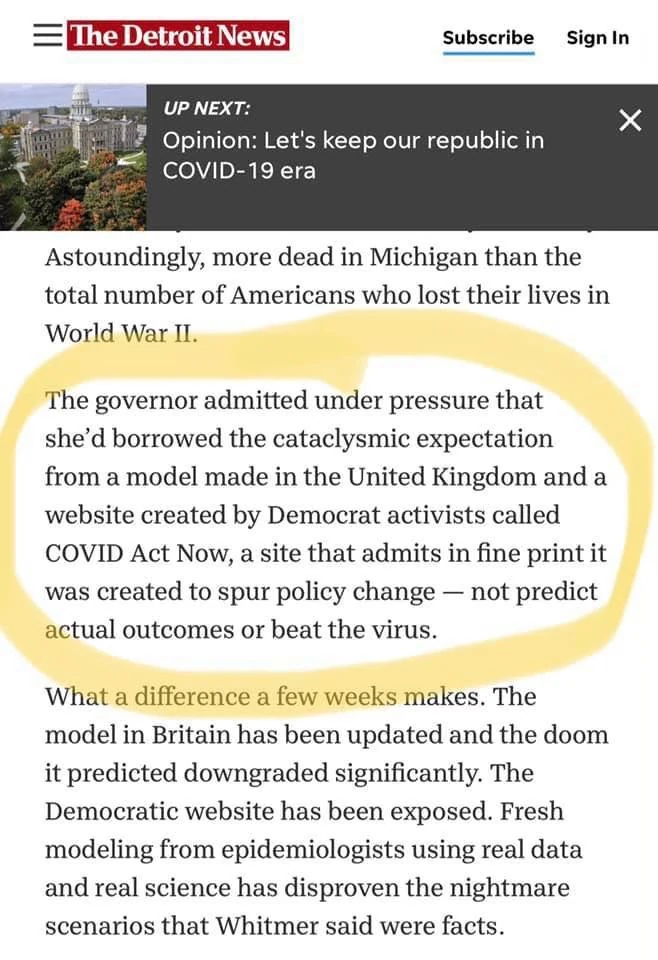
In the earliest weeks of the COVID-19 crisis, fear moved faster than facts. Governments across the Western world confronted a pathogen with limited real-time data but abundant projections. The numbers that dominated headlines were not confirmed death counts; they were models — worst-case forecasts warning of millions dead and hospitals collapsing under tidal waves of infection.
Among the most influential of those projections were those produced by Neil Ferguson and the Imperial College London COVID-19 Response Team. In March 2020, the Imperial model warned that, absent aggressive mitigation, COVID-19 could cause up to 2.2 million deaths in the United States and more than 500,000 in the United Kingdom. Those figures reverberated globally. Lockdowns followed in rapid succession. Emergency powers expanded. Governors cited the modeling logic as justification for unprecedented restrictions.
In Michigan, Governor Gretchen Whitmer invoked emergency authority and implemented sweeping measures. On March 25, 2020, Michigan’s Department of Health and Human Services issued guidance requiring nursing homes to admit COVID-positive residents discharged from hospitals if medically stable. That decision would become one of the most controversial actions of Michigan’s pandemic response.
The Modeling That Shaped the Mandates
The Imperial College model did not simply inform policy; it set the emotional register of the crisis. The forecasts were presented not as one of many plausible trajectories but as looming inevitabilities unless governments acted decisively. In this climate, extreme executive measures felt unavoidable.
Yet Ferguson’s forecasting history had long drawn criticism. During the 2001 foot-and-mouth outbreak in the United Kingdom, his projections of livestock loss were later described by critics as substantially overstated relative to outcomes. During the 2009 H1N1 outbreak, early mortality projections were revised downward significantly as data accumulated.
When COVID modeling was released in March 2020, those prior episodes were not front and center in public briefings. Instead, the new projections carried enormous weight. Governments treated them as urgent warnings demanding immediate structural intervention.
But within weeks, questions emerged regarding transparency and reproducibility. The Daily Economy’s later analysis, “The Failure of Imperial College Modeling Is Far Worse Than We Knew”, detailed concerns about assumption sensitivity and code transparency. Small adjustments to inputs yielded dramatically different outputs — a reminder that these projections were conditional simulations, not fate.
In May 2020, Ferguson resigned from the UK government’s Scientific Advisory Group after violating lockdown restrictions he publicly supported — a development covered by National Review “Professor Lockdown Modeler Resigns in Disgrace,” The resignation intensified scrutiny of both personal credibility and modeling authority.
Even as that credibility eroded, executive policies in multiple jurisdictions, including Michigan, continued under the logic of early catastrophic forecasts.
Funding and the Concentration of Influence
Imperial College’s infectious disease research programs have received substantial funding from global philanthropic institutions, including the Bill & Melinda Gates Foundation. Public grant records confirm significant Gates Foundation support for infectious disease modeling initiatives at Imperial College in the years leading into the pandemic.
When a small group of heavily funded modeling institutions shapes global emergency governance, legitimate questions arise about concentration of intellectual influence and the importance of diversified review before policy becomes law. Thus, predictive science does not operate in isolation. It exists within funding ecosystems, institutional hierarchies, and political environments that amplify certain voices over others.
Michigan’s Nursing Home Directive: A Deadly Decision
Michigan’s nursing home controversy is not simply a tragic footnote of pandemic history. It represents a moment when speculative projections were treated as marching orders and implemented in the most vulnerable setting imaginable.
The March 25th, 2020 directive required long-term care facilities to accept COVID-positive residents from hospitals. These facilities housed elderly individuals with comorbidities — precisely the population most vulnerable to severe outcomes. Even before COVID, long-term care centers struggled with staffing shortages and infection-control limitations.
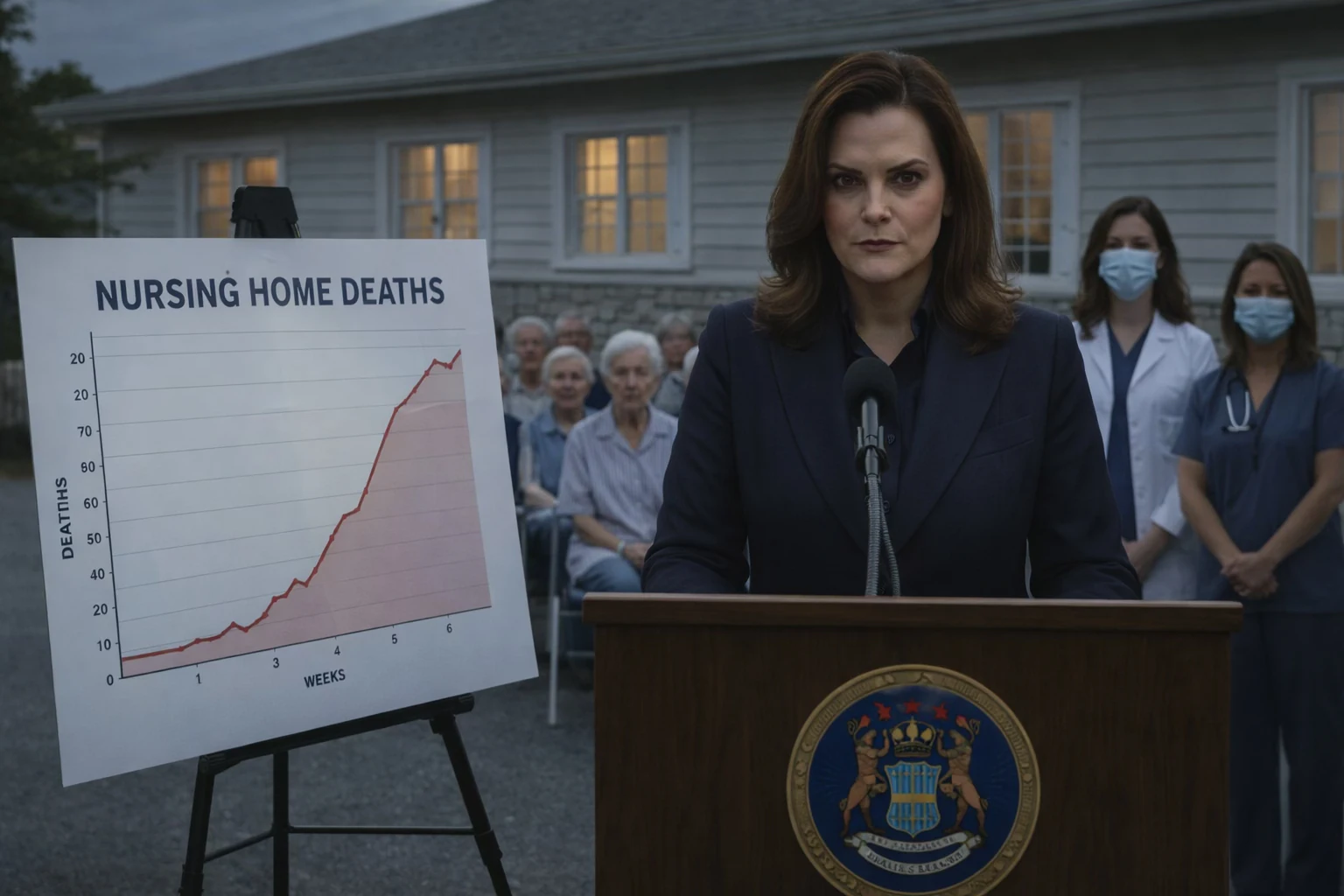
When you compel congregate elderly facilities to admit infectious patients, you are not performing a theoretical exercise. You are introducing foreseeable risk.
Worst-case modeling helped fuel the urgency that made such a gamble politically defensible. But when projections diverged from observed hospitalization realities, critics argue that Michigan did not visibly recalibrate. Emergency measures continued. The modeling logic persisted.
No formal repudiation of Imperial College’s early catastrophic assumptions followed Ferguson’s resignation.
The Undercount That Reframed the Crisis
In 2021, Michigan’s Office of the Auditor General released findings that fundamentally altered the public accounting of long-term care mortality. As summarized by the Mackinac Center, the Michigan Department of Health and Human Services publicly reported 5,675 long-term care COVID deaths as of July 2, 2021. The Auditor General identified 8,061 deaths tied to long-term care facilities for the same period — a 42 percent increase. The audit further estimated that approximately 37 percent of Michigan’s total COVID deaths were traceable to long-term care facilities.
That is not a marginal statistical adjustment. It is a structural recalibration of where the pandemic’s toll was most concentrated.
The implications extend beyond raw numbers. Public understanding of risk distribution informs public consent for emergency measures. If long-term care mortality represented a significantly higher share of deaths than publicly reported, then the narrative surrounding general population risk versus concentrated vulnerability shifts accordingly. Policy trade-offs look different when vulnerability is geographically and demographically concentrated rather than diffuse.
Compounding the gravity of the discrepancy was reporting that an internal June 2020 “miniaudit” indicated roughly 44 percent of deaths identified through death certificates were linked to long-term care facilities. Critics argue that such a finding — emerging early in the pandemic — should have triggered immediate reform in classification, reporting, and public communication. Instead, the public tally remained lower until external review forced recalculation.
MDHHS disputed aspects of the Auditor General’s methodology, citing reporting structures and definitional differences regarding which facilities were required to submit data. But methodological disputes do not erase the fundamental reality: the publicly reported long-term care death count materially understated the auditor’s findings.
When death accounting in the most vulnerable population changes by thousands, trust fractures.
FOIA, Litigation, and the Architecture of Opacity
Transparency in emergency governance is not optional; it is the price of extraordinary authority. Yet the path to clarity in Michigan did not proceed through voluntary disclosure. It proceeded through litigation.
Investigative journalist Charlie LeDuff filed Freedom of Information Act requests seeking foundational data: dates of death, dates deaths were added to the official tally, and whether infections originated within nursing homes. According to the Mackinac Center Legal Foundation, the state resisted or declined to produce certain requested information, prompting legal action.
Settlement disclosures reportedly acknowledged tracking limitations. In some cases, the state was unable to determine when deaths were added to official tallies. In others, it could not definitively identify whether infections originated within long-term care facilities. These were not peripheral data points. They were central to understanding the trajectory of mortality within the state’s most vulnerable demographic.
The Detroit News later published opinion commentary noting that key questions regarding nursing home deaths remained unresolved well into 2022 . The persistence of unanswered questions years after the initial surge deepened public skepticism.
Most recently, the Michigan Enjoyer characterizes this sequence as a “cover-up,” arguing that discrepancies, delayed disclosures, and litigation reflect systemic concealment. What is indisputable from the public record is that death accounting was materially revised upward by independent audit, that internal indicators suggested undercounting earlier than publicly acknowledged, and that legal action was required to obtain certain data.
When a government exercises sweeping emergency powers, citizens reasonably expect the ledger to be open.
Executive Negligence and the Collapse of Accountability
By mid-2020, several facts were visible simultaneously: the Imperial College modeling had been revised; its lead architect had resigned; empirical infection fatality estimates had evolved; and concentrated mortality in long-term care facilities was becoming apparent nationwide.
Michigan’s emergency posture did not visibly pivot in proportion to the evolving data landscape. Whitmer did not publicly distance state policy from the modeling framework that had helped shape early urgency. There was no sweeping public acknowledgment that the catastrophic projections underpinning March decisions had been materially recalibrated.
This is not an argument that leadership should have possessed perfect foresight in March 2020. It is an argument about accountability.
When projections treated as existential warnings are later shown to be highly assumption-sensitive and materially revised, leadership owes the public a transparent reassessment. When concentrated mortality occurs in the precise population exposed by a policy directive, leadership owes the public a rigorous accounting of that decision’s risk calculus.
Instead, critics argue, Michigan offered procedural defenses and methodological disputes rather than institutional introspection.
The Reckoning That Has Yet to Occur
The Michigan nursing home controversy endures because it sits at the intersection of executive authority and data transparency. It is not reducible to partisan theater. It is a structural case study.
History will judge pandemic governance not solely by how leaders acted, but by how they responded disproportionate to outcome and when exaggerated datasets surfaced. Leadership under emergency authority demands not just decisiveness, but humility — the willingness to admit when assumptions shifted and when systems failed.
Until a comprehensive, auditable reckoning addresses the modeling assumptions, the policy calculus, and the mortality concentration within Michigan’s long-term care facilities, the controversy will remain unresolved — not because critics refuse to move on, but because the ledger itself was never fully settled in the open.
Intergenerational Crimes Against Humanity? mRNA's Threat to Tomorrow
Citizens Rule Book: A Palladium of Liberty (Hardcopies) 🇺🇸
Keywords
First published February 14, 2026. Originally published in Liberty or Deathwire.