Dynamic Standards Consensus: A Living Standards Model for STEM Education
How DSC transforms STEM.org Trustmarks into a real-time governance system for participatory and independent standards development.
In this essay +
- Abstract
- Introduction: Governance as the Missing Layer
- Historical Foundation: A Twenty-Five-Year Commitment to Independence
- Defining Dynamic Standards Consensus
- CLEO as the Operating System for DSC
- Architecture of Real-Time Consensus
- DSC as a Counterbalance to Technocracy
- Transparency and the Visibility of Governance
- From Static Standards to Living Systems
- Implications for Global STEM Education
- Final Thoughts
- Closing Statement
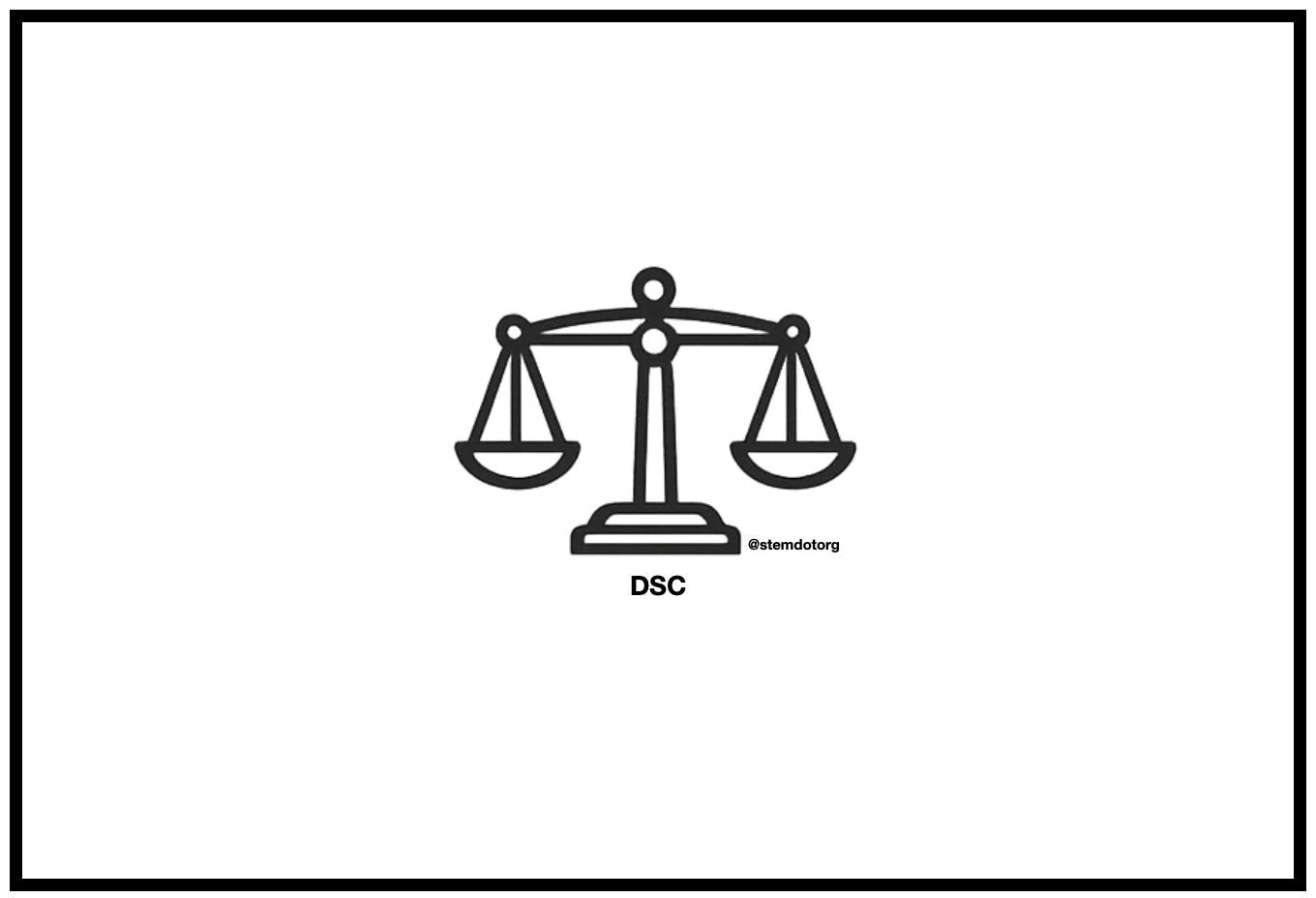
“A credential records a moment. Governance answers for every moment after.”
This is the gap at the heart of credentialism today. The mechanisms for granting recognition eligibility have grown rapidly over the last two decades. The mechanisms for defining, preserving, and altering the standards behind that recognition have changed little. Authority is as it has always been: in small committees, on advisory boards, in institutional hierarchies, and among platform gatekeepers. Organizations that cannot, by design, speak for the size of the movement they seek to regulate.
Abstract
The governance layer of CLEO, Credentialing Logic for Educational Operations, is the Dynamic Standards Consensus (DSC) and its advancement to an inclusive, transparent, and independent standard-setting process representative of the entire world. Dynamic Standards Consensus (DSC) is based on the extensive research and practice by the STEM.org Educational Research team for more than 25 years and enables real-time governance where each verified trustmark holder has the opportunity to contribute to the standards regarding the meaning of what being STEM-aligned means.
The governance of Dynamic Standards Consensus is not only decentralized but also global and transparent from appropriate parties. Instead of setting standards using fixed committee, closed advisory boards or institutional power, Dynamic Standards Consensus distributes decision-making authority to those with credentials throughout the verified network of credential holders around the world. Through the governance logic of CLEO, the standards will change proportionally to the experience of educators, institutions, product developers, publishers and innovators across the globe. DSC replaces the previous structure of technocracy with a system of distributed stewardship where credentialing is not an end to recognition but a mechanism for the sustainability, relevancy and independence of STEM standards into the future.
Keywords: Credentialing Logic for Educational Operations (CLEO), Dynamic Standards Consensus (DSC), living standards, distributed stewardship, credential-gated governance, STEM ID, trustmark holders, real-time standards evolution, decentralized authority, technocracy
Introduction: Governance as the Missing Layer
STEM credentialing systems have grown in size, revealing their fallacy not in credentialing, but in governance. Credentialing systems have proliferated, but systems for defining, validating, and evolving standards have not. Most credentialing systems are defined by the authority of small groups of committees, advisory boards, academic institutions, or platform owners. None of these stakeholders can represent the full diversity, complexity, or dynamism of the global STEM education movement.
The concentration has a small but significant bias. Standards are seen as an expression of a narrow point of view instead of a common experience. Over time, there is a risk that such systems will slide into technocracy — the rule of experts who are increasingly insulated from the view of the educators, schools, organizations, creators, and innovators that participate in the system’s design.
Dynamic Standards Consensus (DSC) is a governance model that fills this gap. DSC is the governance mechanism through which informed, validated, and evolving standards are acquired from a verified community of trustmark holders. Without the operating system provided by CLEO, it would be impossible for this to happen, and voting would be treated as a sideshow, a symbolic act, or an afterthought to the process of credentialing. Instead, voting is treated as a non-negotiable pathway through which standards will remain living, accountable, and responsive.
In this sense, CLEO is the platform and DSC the logic that governs its usage and harmonizes the credentialing processes into a dynamic system of shared governance and stewardship.
Historical Foundation: A Twenty-Five-Year Commitment to Independence
STEM.org Educational Research was founded in 2001 with the mission for one purpose — to ensure that STEM education credentialing was clear and independent. Among its initial contributions to the national landscape for STEM education were the key differences between certification, accreditation, authentication, and review. These were not mere terms, rather the instigation of a mission to retain the integrity of meaning.
For the past 25 years, this commitment has not fluctuated. The organization has withstood political pressures to consolidate a common curriculum, to capitalize on dependency, or to collaborate with other institutions in furtherance of their programmatic aims that might compromise their objectivity. Rather, it has fostered a programmatic vision based on educator-first led standards, transparency, and methodological autonomy.
Dynamic Standards Consensus is a continuation of that tradition. It is not a new concept that has been forced into the system. It is the natural evolution of a philosophy that values distributed power over centralized influence going back to the earliest days.
As opposed to credentialing models which previously used stable standards that were inspected at intervals via reviews, DSC proposes a governance model that is responsive to change as it acknowledges that different possible representations would require a standard that is sufficiently stable to have meaning, yet fluid enough to allow for variations to correspond closely to actual circumstances encountered in the field. It is through CLEO that such stabilization and fluidity may be achieved.
Defining Dynamic Standards Consensus
Dynamic Standards Consensus is the method through which verified participants in the STEM.org trustmark ecosystem participate in the actual, credential-gated voting process to effectuate the evolution of standards. Voting on CLEO is not a one-time event and it is not a statement or an abstract process. Voting on CLEO is continuous, systematic and substantive.
All individuals or organizations that obtain a STEM.org Trustmark™ shall have the ability to engage in the stewardship governance through a verified identity — STEM ID. The STEM ID shall be used for credential verification and voting access to ensure only those verified against established standards are allowed to participate.
DSC manages the realms of the trustmark framework. In these, they may establish, as an example, the evaluation criteria, the rubric component-weighting, revise already established standards but also create a new of them, develop/propose new areas of discussion, or focus on the emerging ones as they can be by trustmarks categories/regions/contexts/sectors and others. Each of the vote is being registered, counted and applied accordingly to the rules internally embedded within the system.
This structure produces several defining characteristics:
- Distributed Authority: There is no single committee, platform owner or governing body that has exclusive control over standards. Rather there is a compound authority existing with the global network of verified trustmark holders.
- Real-time evolution: Standards evolve not only through corralled debate or regular institutional review. They evolve as competent inputs are corroborated, weighted, and aggregated.
- Trustmark holders and verifiable participants only can participate in governance, ensuring trusted governance.
- Transparency of Outcome: The result of voting is visible in the system; Changing of standards is not arbitrary or hidden.
Eventually, governance is not layered on top of credentialing in this approach — it is within credentialing. The organization becomes the missing layer in which recognition, standards, verification and community involvement can all work together.
CLEO as the Operating System for DSC
CLEO — the Credentialing Logic for Educational Operations — is the foundational operating system for which Dynamic Standards Consensus is actionable. Absent an operating system for capturing and managing credential identity, civilization trustmark categories, scoring rules, voting rights, verification status, and standards lifecycle, the decentralized governance method itself would be an incomprehensible ideal.
CLEO makes DSC operational.
Its architecture ties credential creation to governance participation. By being recognized by the system, a trustmark holder also takes part in the future development of that system. The STEM ID is the mechanism that enables this participation alongside recognition. A verified community can now participate in standards development, but development is not opened up to would-be anonymous interference or influence from those not qualified to take part.
This is a significant difference. DSC is not an open voting as in the common understanding. It is neither a popularity competition nor a platform where standards can be dynamically changed depending on collective mood. It is a consensus model based on verification, where participation is based on credentialed alignement and rules of governance.
The deterministic logic required to maintain coherency in such approach is provided by CLEO. It has the ability to differentiate trustsmark’s types, apply weighting, record level of participation, maintain history of voting and guarantee that standards are changing according to pre-defined rules instead of arbitrary pressures.
Thus, CLEO acts as trustmark operating system and Dynamic Standards Consensus acts as trustmark governing engine.
Architecture of Real-Time Consensus
The technical architecture backed by the DSC follows CLEO’s general objective on deterministic logic and continuity of operations. The voting mechanism is entered into a rules-based system that analyzes the thresholds, weighs the contributions, and identifies when hits standards are modified.
In contrast, this mechanism adds provisions for establishing the criteria for change and allows for more moderate reforms. For example, the collective decision to introduce a new evaluation criterion may also depend on the ability to reach a minimum level of support and participation from each of the geographic regions, trustmark types, or group of stakeholders. Likewise, modifications to the previous standards would be allowable only to the extent that they do not abruptly modify the existing system.
This leads to a kind of guided decentralization. Where all valid contributors can participate but the output is based on a logic such that it retains its nature and continuity.
Crucially, no technology interface is unique to this architecture. User dashboards, artificial intelligence platforms, verification tools, data visualizations, and similar devices can facilitate input deduction. However, the governing logic remains inherent to CLEO. DSC will remain a property of the architecture, not of the technology.
To preserve integrity of the process, the abstraction is necessary from the platform. Technology has an expiration date, while this governance concept is time-proof: all validated participants represent and govern the process of continuous existence of the standard based on a transparent consensus model governed by rules.
DSC as a Counterbalance to Technocracy
However, the credentialing systems have also brought about risks. The new credentialing systems emerge with technology. The stakeholders develop technology-oriented solutions, such as platforms. As a result, the credentialing platform requires complex data calculations with expertise. Stakeholders must rely on those in authority who may have greater control of the system. Stakeholders begin to follow calculated decisions that arise from the system rather than informed decisions made through a transparent process. The stakeholder are now subject to systems directed by algorithms that may not be accountable by the stakeholder.
Dynamic Standards Consensus is a structural counterforce to this trend. By embedding governance within a worldwide distributed network of certified participants, CLEO makes sure that no centralized hierarchy is possible. No rules, no standards can be changed through internal decision-making, algorithmic bias, institutional coercion, or external disruption. It is and it has to be a matter of structured membership decision-making.
It does not dismiss expertise. Rather, it considers its place within a wider ecosystem of expertise and experience. Researchers, educators, institutions, publishers, product developers, innovators all share a common responsibility in the development of standards that are informed by context. The result is a theoretical and practical framework.
Centralization is not an ideology, it is an understanding that decentralization is a structural control and functions such that DSC keeps the standards which control the recognition of STEM accountable to it.
Transparency and the Visibility of Governance
Another unique feature of Dynamic Standards Consensus is its transparency. Voting is not hidden behind institutionalized bodies, nor is the outcome behind the closed doors of institutionalized deliberation. Instead, CLEO provides transparent access to visibility of the voting and impact of the vote.
Holders of a STEM.org trustmark can observe changes to standards over time, including extra standards added, modified weightings of established standards, and an increasing number of dimensions of evaluation. This visibility creates additional confidence in the system, as constituents will be able to see how interventions from the trust communities have affected and altered systems.
Lastly, transparency ensures accountability. The visibility of votes means they can be questioned by the members of the same society that produce these votes. There will be a vicious cycle in which governance can be perpetually interrogated and improved.
Governance processes henceforth contribute to determining trust in the DSC significantly. Trust of the model is not just related to the organization that issues it, but how the governance process of the DSC is transparent: people know that there is governance and they can see how it is created, modified and maintained.
From Static Standards to Living Systems
The traditional credentialing systems follow a standards-centric model. They perceive standards as fixed entities that do not change from point in time to another, unless by prescribed periodic interventions. CLEO endeavors shift from this standards-based credentialing system to the Dynamic Standards Consensus model, with standards as evolving entity continually updated by those who interact with the standard.
The practical value of this transformation lies in the fact that the system can absorb evolving technologies, pedagogies, geographical diversity, and new forms of STEM learning without a need for centralized system revision cycles. Standards can continue to be responsive to the needs of students by not attempting to forecast every eventuality that will challenge previously prepared standards prior to implementation but by being responsive to change as it occurs.
DSC creates an environment where governance is no longer event-based, but rather state-based. Voting is not an action that is taken; it is a condition of being in the system.
So, this is the deeper meaning of CLEO’s governance as the missing layer. A trustmark system without governance can determine alignment at an instant in time. A trustmark system with DSC can maintain alignment over time.
Implications for Global STEM Education
In the Dynamic Standards Consensus model, standard setting is a distributed control system. This decentralized approach achieves a better fit to the size and diversity of the STEM movement by relieving it from centralized authorities.
Such approach has numerous benefits for the standards. First of all, it provides higher legitimacy to them because they are derived from common experience. Second of all, it protects from regional prejudice, as each geographical area has its own representative. Third of all, it reinforces resilience, since there is no single point of failure. Finally, it provides further sense of ownership to people who work inside the STEM ecosystem.
After the evolution of standards, now the developers, educators, institutions, publishers, product designers and innovators can proactively take part in contributing to standards.
This is crucial to the direction of the educational model internationally for the STEM discipline. A standard developed from above can ensure adherences to a norm, yet a standard achieved through credible engagement has a legitimacy value. The standardized development of standards compliance has made attainable that legitimacy.
Final Thoughts
Dynamic Standards Consensus launched through CLEO is a crowning achievement in the development of a governance philosophy dedicated to independence and longevity. It embodies and expands the guiding principles that STEM.org Educational Research has established.
Thereby, It tackles the key issue of current credentialing: coherence vs centralization and evolution vs delegation to black boxes.
To meet this challenge, CLEO strategically embeds governance in its logic. Through DSC, the evolving standards are not only defined by all participating STEM stakeholders but also continually amended by them.
Closing Statement
Dynamic Standards Consensus is not a bolt-on. It is the mechanism of governance that preserves the integrity of the CLEO system. DSC makes it possible for the credentialing process of every verified trustmark holder to evolve continuously, in real time, collaboratively, and transparently.
In a movement towards technocracy where all forms of life are carefully and cruelly monitored by the AI, algorithm-based authorities, CLEO offers a contrary model: one in which independence is preserved, transparency is the default, and the meaning of recognition is sustained through collective stewardship.
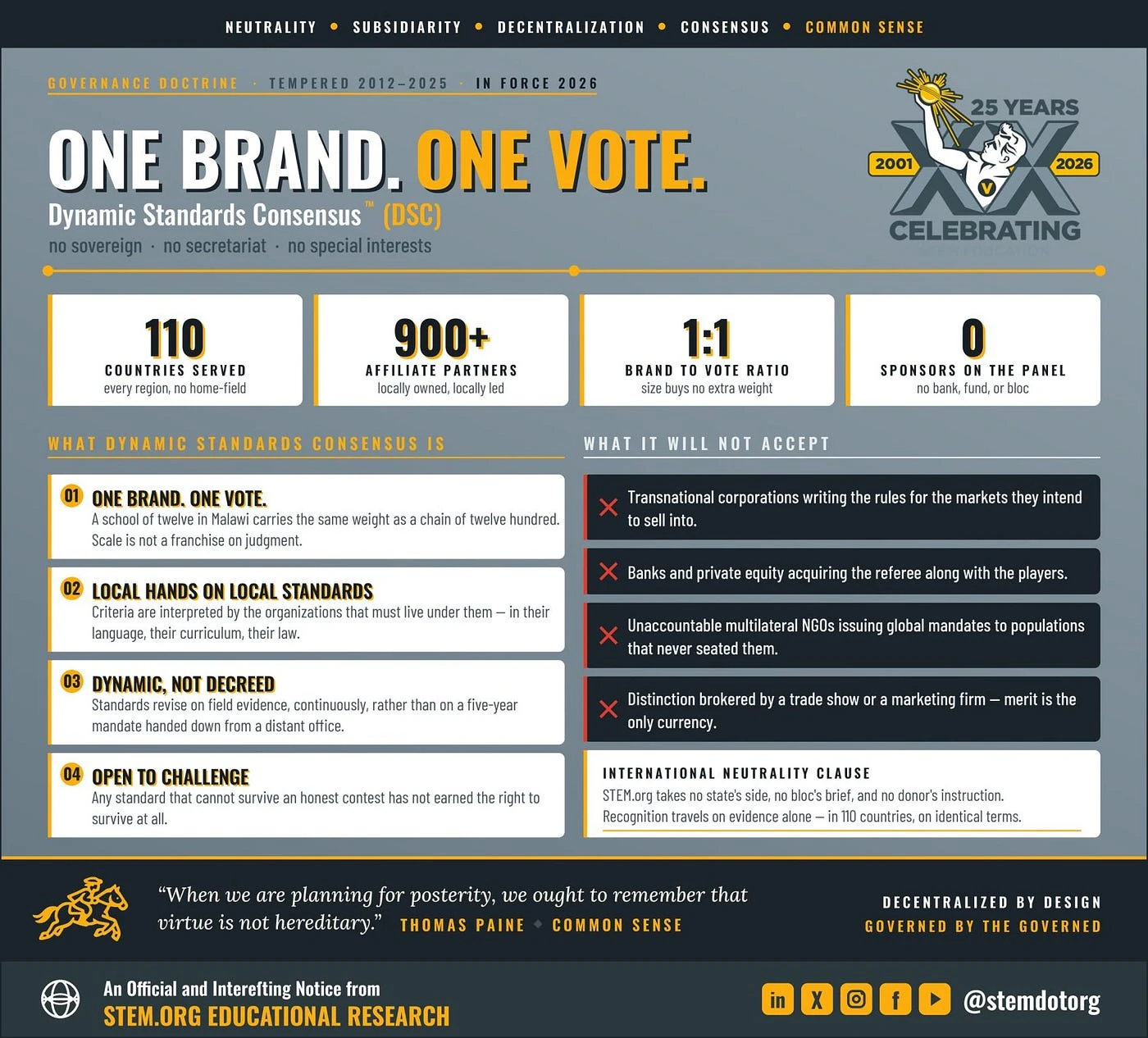
Andrew B. Raupp is the Founder / Executive Director @stemdotorg. “Resolutely preserving the rights and freedoms of the STEM education community through sound policy & practice… Credentialed member of the International Federation of Journalists and National Writers Union”
Keywords
First published July 29, 2026. Original publication