Whose Future Are We Building? The Ethical Crisis in STEM
Digitizing the American Dream Into a Technocratic Feudal State
In this essay +

In an age when our lives are increasingly quantified, tracked, and analyzed, a pressing question confronts us: Have the tools of science and engineering — meant to liberate and empower — been commandeered to erect a new kind of tyranny? We hear whispers of “technocratic feudalism” in which data lords and algorithmic gatekeepers gain power akin to feudal barons, ruling through surveillance and control. Yet the spirit of STEM (Science, Technology, Engineering, and Mathematics) was never meant to serve tyrants or subjugate the masses. Its origins were profoundly civic and democratic, rooted in the belief that knowledge lights the path to freedom. This feature explores the collision between these two realities: the emergence of a high-tech surveillance state on one hand, and the original American vision of STEM as a wellspring of innovation, inquiry, and empowerment on the other. In the fiery spirit of Thomas Paine, let us examine the evidence and reclaim the moral compass of STEM.
When Data Becomes Dominion
The United States today is witnessing an unprecedented fusion of Big Tech and Big Government in the realm of surveillance. Consider Palantir Technologies, the secretive data-mining firm co-founded by a Silicon Valley billionaire and nurtured with intelligence-agency seed money. Palantir has secured itself as a linchpin of federal data analytics: it has reportedly received more than $113 million in government contracts since 2017 and even landed a $795 million Pentagon deal to create a centralized platform integrating citizen data across agencies. Under the previous administration, officials sought to “merge information from different agencies” using Palantir’s technology — a scheme to fuse databases of biometric IDs, behavioral records, and location tracking into a single, all-seeing system. The New York Times revealed that this centralized “national citizen database” could be wielded to “police immigrants (illegals) and punish critics,” a prospect that prompted alarm about a digital dragnet sweeping up every American’s personal details.
There Are No Lowercase Letters in STEM
Palantir is but one vassal in a larger technocratic empire. Amazon, too, has thrown open the gates of a “new neighborhood watch” by integrating its consumer technology with law enforcement. By 2019, Amazon’s Ring doorbell division had quietly brokered video-sharing partnerships with over 400 police departments; today that number has swelled to more than 1,400 police agencies nationwide. Through these partnerships, police can request homeowners’ camera footage for specific times and places without a warrant, tapping into a sprawling network of millions of private cameras. Once obtained, the footage can be stored indefinitely and even shared with federal agencies like DHS and the FBI. What would have sounded like paranoid fantasy years ago — the notion of thousands of citizens voluntarily webcasting their doorsteps to police databases — is now mundane reality.
Amazon’s Ring frames its service as an opt-in safety tool, but civil liberties experts are sounding the alarm. This “eyes-everywhere” system, they warn, can easily transform neighbors into informants and subject innocent people — especially those flagged as “suspicious” for nebulous reasons — to pervasive surveillance. “If the police demanded every citizen put a camera at their door and give officers access, we might all recoil,” notes one law professor, yet Amazon’s clever workaround has normalized the same outcome.
Surveillance is not limited to cameras on our porches. Amazon has also marketed facial recognition technology (branded as Rekognition) to law enforcement, prompting fierce criticism. An investigation by the ACLU revealed Amazon’s eagerness to sell this powerful tool to government, “warning that the deployment of the technology could be the beginning of automated mass surveillance in America.” The specter of police scanning crowds with AI-powered face matching — identifying, tracking, and profiling anyone within range — chills the spine of any freedom-loving citizen. Indeed, Amazon’s own employees balked at this direction: in 2018, hundreds of Amazon workers signed a letter to CEO Jeff Bezos declaring “we refuse to build the platform that powers ICE, and we refuse to contribute to tools that violate human rights.” They drew historical parallels to IBM’s complicity in 1930s fascism and vowed “we will not let that happen again.” Here were STEM professionals on the front lines, pleading for restraint and ethics as their company edged toward ever deeper collaboration with agencies involved in mass surveillance.
Deploying this technology on those who are in America illegally may make citizens more safe — but at what expense?
Google offers another instructive example. This quintessential tech success — once famed for the motto “Don’t be evil” — has amassed oceans of data on billions of users, from search queries and emails to real-time location tracking of Android phones. Such data troves are honey to the authorities. U.S. law enforcement routinely serves Google with “geofence warrants,” compelling the company to hand over anonymized location records of any devices in a certain area at a certain time, a practice privacy advocates decry as a digital dragnet capturing innocent bystanders. (Only after narrowing down suspects from this data does police then petition Google to unmask specific users.) Google, along with other tech firms, was also implicated in the NSA’s PRISM surveillance program exposed by Edward Snowden in 2013, where companies were compelled to facilitate government access to user data under secret court orders. Beyond data-sharing, Google’s expertise has been directly enlisted for military projects. In 2017 the company quietly partnered with the Pentagon on Project Maven, an effort to apply artificial intelligence to analyze drone surveillance footage. The goal: use AI to identify targets in war zones, potentially streamlining lethal drone strikes. When news of Google’s involvement reached the public (and Google’s own staff), it ignited an ethical firestorm. Nearly 4,000 Google employees signed a petition in protest, and about a dozen even resigned rather than be complicit in turning AI research toward killing. These engineers and researchers argued that algorithms should not decide matters of life and death, and that Google’s participation in such military work betrayed the values of the community. Facing mounting pressure, Google’s leadership backtracked — they announced they would honor the Maven contract only until its expiration in 2019, would not renew it, and even issued new AI ethics guidelines pledging not to develop “AI weapons”. This remarkable episode showed that STEM workers themselves can recoil at how their inventions might undermine freedom or human rights. It was a very public collision of high-tech ambition with age-old ethics.
When AI Predictions Fail and STEM Prevails
Meanwhile, lesser-known firms are building the last mile of the surveillance highway. Take Clearview AI, a startup that has unabashedly scraped billions of images from social media and the internet to create what it boasts is the world’s largest facial recognition database. Clearview’s software enables an officer to upload a photo of any person — say, from a street protest or a security camera — and within seconds get matches to that person’s online photos, along with links to their identity and personal profiles. By 2020, Clearview claimed to have over 3 billion images in its dataset (pulled from Facebook, YouTube, Venmo, and countless other sites) and was marketing its service to hundreds of police agencies. Most of the public had never heard of Clearview until investigative reporters and concerned academics exposed its activities. Even the New Jersey Attorney General was “surprised” to learn his own officers were using Clearview behind the scenes. This lack of transparency exemplifies how cutting-edge surveillance tools often spread in darkness, outpacing public debate or legal safeguards. Clearview’s approach — deploy first, ask permission (or forgiveness) later — highlights the ethical vacuum that can arise when profit and power drive technological deployment faster than democratic processes can respond. It has prompted calls from organizations like the EFF for an outright ban or moratorium on law enforcement facial recognition. Yet in the absence of strong regulations, such technologies continue to proliferate, quietly eroding the practical anonymity that free society has long taken for granted in public spaces.
Across these examples, a disturbing ecosystem emerges. Palantir’s data platforms, Amazon’s nationwide camera networks and cloud services, Google’s algorithmic might, Clearview’s biometric catalogues — each is a node in an evolving surveillance and control grid. They thrive on an ideology that views information as the ultimate instrument of power. It is a vision in which our every move, transaction, and even emotion (scraped from social media) can be vacuumed up and analyzed to predict and influence behavior. In such a world, privacy becomes a quaint relic, and autonomy an illusion; citizens are reduced to data points to be cross-referenced and, if deemed troublesome, constrained. This system is often justified under banners of “security” or “efficiency.” But we must call it by its true name: a technocratic tyranny growing in our midst. Like Paine warning of monarchy’s encroachments, we must not sugarcoat the reality that unchecked technological power concentrated in a few hands is fundamentally at odds with liberty. The situation recalls the metaphor of a “panopticon,” an all-seeing prison where the inmates can never escape the guard’s gaze. Indeed, one constitutional lawyer described the current trend as “transforming America into a digital prison… where the inmates are told they’re free” even as every move is monitored. This is not paranoid hyperbole but a genuine risk when corporate and state interests align to surveil and algorithmically manage society.
Meant to Uplift, Never to Control
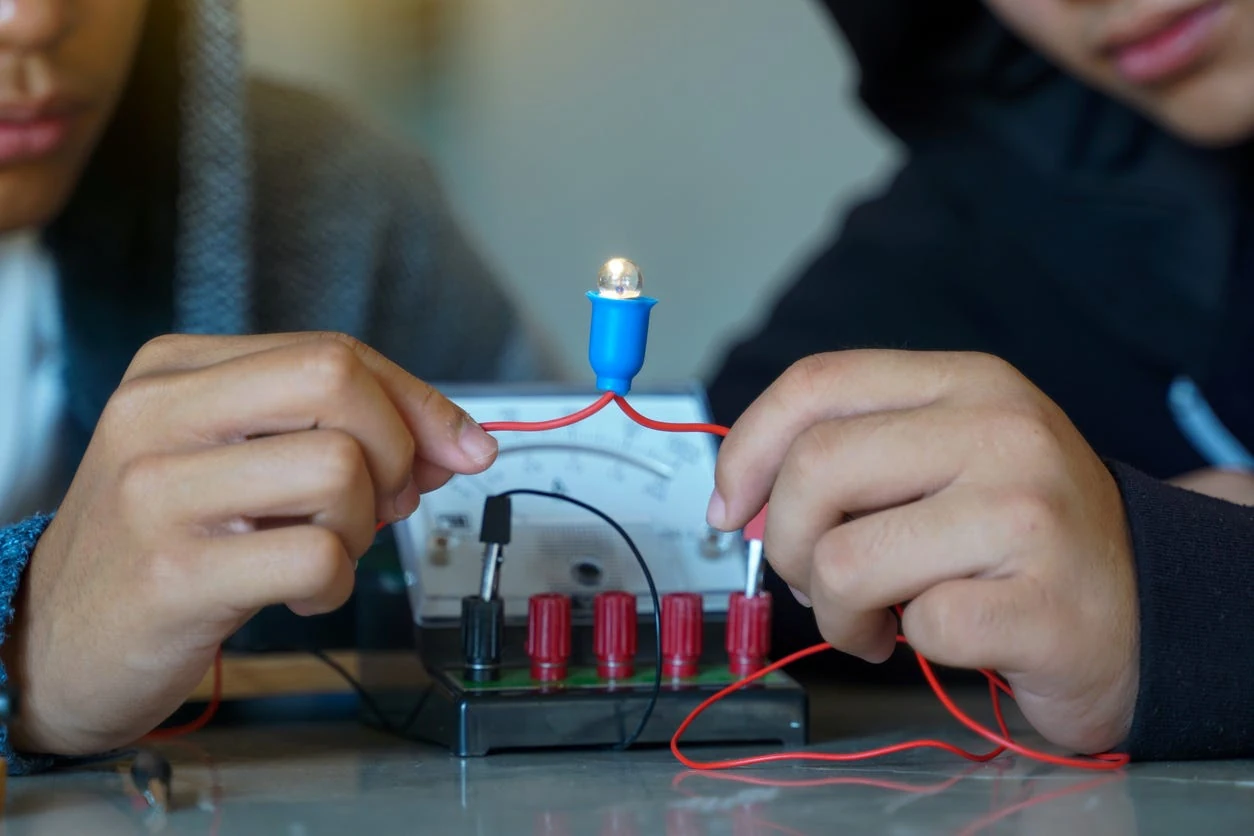
How did we arrive at this perilous juncture? To fully grasp the wrongness of converting STEM into an instrument of control, we must revisit the noble origins of the STEM enterprise. America’s great experiment in public education and scientific advancement was animated by profoundly civic-minded values. STEM education, as a concept, took shape to propel national prosperity, solve grand challenges, and empower citizens with critical thinking skills. It was never about creating cogs for an authoritarian machine; it was about creating innovators and informed citizens for a vibrant democracy or constitutional republic.
We can look, for instance, to the work of Congressman Vernon Ehlers, a physicist-turned-lawmaker who became one of the early champions of STEM education policy. Ehlers, a Republican from Michigan, co-founded the bipartisan STEM Education Caucus in the U.S. House of Representatives in 2005, at a time when the term “STEM” itself was just entering the popular lexicon. He recognized that America’s leadership in science and technology was not preordained; it required conscious cultivation through education and investment. But Ehlers’ vision for STEM went far beyond churning out technicians to fuel corporate profits or government labs. He advocated a holistic transformation in education, emphasizing experiential, hands-on learning that would ignite students’ curiosity and problem-solving skills. He tirelessly worked to dismantle barriers that kept women, minorities, and other underrepresented groups out of science and engineering, debunking antiquated myths about who could succeed in these fields — focusing on meritocracy. In Ehlers’ view, STEM was an educational foundation for the nation — nothing less than a pillar of citizenship in the modern age. He understood that a scientifically literate populace is better equipped to engage in our society, to make wise decisions, and to hold leaders accountable on issues ranging from environmental stewardship to national security.

This civic vision of STEM harkens back to the Enlightenment ideals on which the United States was founded. Knowledge, in the American tradition, is meant to diffuse power, not concentrate it. Thomas Jefferson dreamed of an “empire of liberty” sustained by educated citizen-farmers; Benjamin Franklin, that archetypal tinkerer, established libraries, universities, and scientific societies for the public good. In the 20th century, the launch of Sputnik spurred America to redouble investment in science and math education, not to build a surveillance state, but to unleash innovation and ensure the nation’s competitive vitality. Even during the Cold War, when science was enlisted in the service of defense, there was widespread agreement that open inquiry and broad education were sources of strength — antidotes to tyranny, not tools of it. Congressman Ehlers echoed these principles, framing STEM as crucial for national prosperity and security in a way that enhances liberty. A congressional report at the time warned that weaknesses in STEM education threatened America’s future power. The answer was to strengthen education at all levels and widen participation, thereby securing both economic opportunity for individuals and technological leadership for the country.
Ehlers’ life offers a telling anecdote: he was passionate about getting government and industry to use technology in “socially healing ways.” Those who knew him recall that he consistently linked science with social good, urging that new innovations benefit the public and heal societal ills rather than exacerbate them. This ethos — using technology to better peoples’ lives and communities — sits diametrically opposed to the notion of technology as an instrument of coercion. The early STEM education movement that Ehlers helped formalize was imbued with optimism. It aimed to “provide a blueprint for fostering an environment where curious minds could thrive unrestricted, exploring science, technology, engineering, and mathematics without bounds.” In that spirit, initiatives blossomed to encourage project-based learning, science fairs, robotics clubs, and research opportunities for youth. The idea was to cultivate free thinkers and bold innovators who would expand the frontiers of human knowledge and solve real-world problems — whether curing diseases, inventing new industries, or exploring energy independence.
Crucially, the STEM push was also about autonomy and empowerment. A population well-versed in STEM is less easily misled by propaganda or pseudoscience. It can engage rationally with policy debates on geoengineering, climatism, public health, infrastructure, and beyond. STEM skills enable individuals not only to get good jobs, but to invent their own jobs and companies, to be creators instead of just consumers. In short, the founding vision of STEM education was individual and societal empowerment — making each person an agent of discovery and progress, rather than a compliant subject in some technocratic hierarchy. STEM was meant to produce citizen-scientists, people who wield knowledge as a shield against tyranny and a tool for collective betterment.
How tragic, then, to see any suggestion that STEM could become an instrument of “technocratic feudalism.” The term itself — feudalism — implies a rigid hierarchy of lords and serfs, the very antithesis of the fluid social mobility and enlightenment that science promises. American STEM was conceived in a rebellion against old hierarchies. It grows out of the revolutionary idea that talent and truth can come from anyone, not just an elite priesthood. The notion that today’s STEM graduates might simply serve a new elite of data barons and surveillance chiefs would be a bitter betrayal of this heritage.
Designing the Future, Defying the Self
If the ideals of STEM stand at odds with oppression, why do we see so many scientists and engineers entangled in developing tools of centralized control? This is the paradox of our time: the very people educated to advance human welfare are often directed — by corporate or government imperatives — toward projects that may undermine human freedom and dignity. Increasingly, young professionals in tech fields find themselves at an ethical crossroads. They are asked to create technologies that, in the wrong hands or contexts, could diminish their own rights and the rights of their fellow citizens.
One glaring example is the push toward automation and AI, even when it threatens the livelihood and autonomy of workers. Bright minds in software engineering and robotics are tasked with designing AI systems to replace human labor across industries. On one level, this is the natural progression of innovation improving efficiency. But when AI is deployed without a safety net or a humane economic plan, it becomes a guillotine slicing away jobs and concentrating wealth. Startlingly, even highly skilled STEM workers are not immune — software that writes software (powered by machine learning) is on the horizon, meaning engineers could automate aspects of their own work. The great irony is developing: those who code the algorithms of automation may be sowing the seeds of their own obsolescence, programming themselves out of a job. Without careful foresight, AI could lead to a stratified society where a small technocratic class owns the algorithms and the masses, displaced from meaningful work, become modern-day serfs sustained by meager stipends or gig labor. This is not the liberated future that STEM pioneers envisioned; it is a dystopia of alienation. The fault lies not in the technology per se, but in the values (or lack thereof) guiding its implementation. When profit and control are the only lodestars, the human cost is an afterthought.
Nowhere is the ethical tension more palpable than in the realm of military and security R&D. The rise of autonomous weapons and AI-driven warfare presents a direct challenge to the moral instincts of many engineers. The idea of crafting machines that can make life-and-death decisions — killer robots, in plain terms — troubles the conscience and raises profound questions. In fact, a global movement has emerged to ban or restrict lethal autonomous weapons, with over 30 countries (and the United Nations Secretary-General) calling such systems “politically unacceptable and morally repugnant.” UN experts warn that removing human control from targeting decisions not only violates humanitarian principles but also poses a “direct threat to human rights and fundamental freedoms.” Yet despite these warnings, advanced militaries and defense contractors (including many tech startups) sprint forward in an arms race to develop ever more autonomous drones, robotic sentries, and AI battle management systems. The engineers writing this code and designing these platforms often wrestle with grave concerns: Are we building a world where warfighters become bystanders and killing is done by algorithm? Can an AI truly understand the Geneva Conventions or the value of a human life? Many in the STEM community say no — and they have acted on that conviction. We saw it in the Project Maven uproar at Google, where talented AI researchers stood up and said “Not on our watch”. Similar rumblings have occurred at other companies: Microsoft employees protested their company’s contract to develop augmented reality headsets for U.S. soldiers, and workers at a smaller AI firm might question a project quietly supplying surveillance tech to an authoritarian regime. These incidents reveal a heartening truth: the moral conscience of STEM professionals is alive. They are not unthinking cogs; many recognize the potential for abuse in the technologies they create, and they demand accountability.
On the Dawn of a New Revolution: When STEM Lights the Path to Peace
Even beyond defense, many STEM graduates in big tech companies face subtler pressures that pit their personal ethics against corporate directives. A data scientist might be asked to refine an algorithm that inadvertently reinforces social biases (as seen in some facial recognition or predictive policing tools). A programmer could be maintaining code for a social media platform that amplifies disinformation or undermines elections. A biotech researcher might be courted to develop invasive biometric sensors or gene editing techniques without adequate ethical guardrails. Each scenario raises the question: Will the expert become the enabler of a system that ultimately diminishes individual agency and government by the people? The disillusionment among some tech workers is palpable. Many entered STEM fields inspired by science fiction dreams of bettering humanity — curing diseases, exploring space, connecting people. They did not sign up to build a “digital Leviathan” that monitors citizens’ every move or a labor market where humans compete with ever-more omniscient AI.
Tragically, some young technologists feel trapped. They carry student debt, have visas tied to employment, or simply feel career pressure to conform, making it hard to just quit in protest. Corporate culture can sometimes dismiss ethical objections with platitudes (“If we don’t build it, someone else will” or “We’re just following orders/specs”). This mentality eerily echoes the defenses offered by scientists in darker chapters of history who enabled harmful regimes. But there are also stories of courage: insiders leaking information about abuses, engineers transferring out of ethically dubious projects, and whistleblowers calling attention to privacy invasions. These modern Paul Reveres of the digital age do society a service by warning of threats before liberties are lost.
The conflict between one’s role as a technologist and one’s duty as a citizen is now a defining challenge of the STEM professions. It forces a reckoning: education in STEM cannot be merely technical. It must include the cultivation of ethical judgment and civic virtue. Otherwise, we risk producing brilliant engineers and scientists who lack the moral north star to navigate how their inventions are used. As one group of Amazon employees wrote in an open letter, “As ethically concerned Amazonians, we demand a choice in what we build, and a say in how it is used.” This plea captures a longing for agency and integrity: they do not want their talents used for ends that betray their values. It is a reasonable demand that speaks to the core of human dignity. No worker wants to wake up to find the code they wrote last year is now powering oppression or facilitating abuses. Yet that risk grows daily in a world where ethical oversight lags behind technological capability.
Saving Innovation From Itself
What, ultimately, are we promoting and pursuing STEM for? This question — moral, philosophical, and urgent — must be raised in every boardroom, classroom, and lab. If we reduce it to merely a pipeline for corporate and military interests, we betray its original purpose and jeopardize our own future. The time has come to restore its deeper mission by insisting that it align with patriotic and humanistic values.
Firstly, we need an ethical framework in STEM education and practice as robust as our technical curricula. This means teaching young scientists and engineers to think critically about the societal impacts of their work. It means empowering them to voice concerns and equipping them with a strong sense of self that can resist immoral directives. Universities and professional bodies have started moving in this direction — integrating ethics modules into computer science and engineering programs, and drafting codes of conduct for AI research. These efforts must be intensified. Just as medical students recite the Hippocratic Oath to “do no harm,” perhaps engineering and computer science graduates should take a pledge to uphold privacy, fairness, and human rights. At minimum, ethical literacy should be seen as part and parcel of STEM proficiency. We want our brightest minds not only to be clever, but also to be wise.
Ethics in STEM Education: Going Beyond the Classroom
Secondly, there is a need for public policy and civic action to catch up with the technology. Civil liberties do not automatically protect themselves; citizens must demand transparency and accountability for how surveillance tech is deployed. This could involve updating laws — strengthening privacy protections, regulating the use of AI in policing, banning the most egregious forms of mass surveillance, and setting boundaries on autonomous weapons. Indeed, other “democracies” are grappling with these issues: the European Union is working on an AI Act to regulate high-risk AI systems; international bodies like UNESCO have adopted AI ethics recommendations to ensure technology “benefits humanity”and respects human rights. These show that alternatives to technocratic dystopia are being taken into consideration — with skepticism. Technology can be harnessed in open, accountable ways if we the people insist on it. In the global arena, scientists and ethical thinkers from many countries (including the US) are collaborating on standards for AI transparency, data protection, and digital rights. The United States should be at the forefront of this movement, true to its values, rather than lagging behind or, worse, exporting a model of surveillance capitalism to the world.
Finally, and most importantly, we as a society must rekindle a civic fervor for human dignity in the technological age. This is a spiritual point as much as a practical one. If Thomas Paine were alive today, he might remind us that the ends we pursue matter as much as the means we use. Prosperity and security, while important, ring hollow if purchased at the cost of our fundamental freedoms. We should measure progress not just in gigabytes and patents, but in how much safer, freer, and more enlightened our people become. The true promise of STEM is to expand the realm of the possible for every individual — curing illness, broadening knowledge, deepening connection — while safeguarding the liberty that gives life meaning. It is to replace ignorance with insight, drudgery with invention, and fear with hope. STEM was never meant to concentrate power in an unaccountable few; it was meant to empower the many.
The words of Paine echo with renewed clarity: “It is not in numbers, but in unity, that our great strength lies.” The unity we need now is a unison of purpose between our technological advancement and our ethical advancement. We must not surrender to the siren song of a high-tech feudalism where we trade our liberties for the illusion of security or convenience. Instead, let us assert with common sense and uncommon courage that STEM and STEM education are instruments of liberation, not tools of tyranny. With a moral framework as our guide and the flames of our founding ideals to light the way, we can ensure that innovation and surveillance are kept in proper balance. We can insist that the digital revolution serves the cause of human freedom — not the other way around.
STEM 250: Championing Liberty in the Battlefield of Ideas
In this pivotal moment, every stakeholder has a role: educators nurturing ethical engineers; tech workers speaking truth to power; legislators drawing hard lines to prevent abuse; and everyday citizens refusing to be passive subjects of surveillance. The call to action is clear. We must demand that our technology reflect our values, and not allow our values to be bent to technology’s whims. For if we succeed, we will have not only rescued STEM from misuse, but we will have also fortified the very foundations of our democracy for generations to come. The choice is ours — and history is watching.
Andrew B. Raupp is the Founder / Executive Director @stemdotorg. “Resolutely preserving the rights and freedoms of the STEM education community through sound policy & practice…”
Your Business — On AutoPilot with DDImedia AI Assistant
(Join Our Waitlist)
Keywords
First published June 19, 2025. Original publication