
The Mathematical Incompleteness of Technocracy
A Gödelian-Raupp Refutation of Algorithmic Governance, Dataism & Harari's Myth of Computable Man
In this essay
- STEM Gnosis as an Epistemological Framework
- The Key Tenets of STEM Gnosis
- COROLLARY
- ONE-LINE FORM
- I. The Principle of Epistemic Humility
- II. The Provisional Nature of Models
- III. The Rejection of Reductionism
- IV. The Distinction Between Tool and Authority
- V. The Principle of Irreducible Complexity
- VI. The Preservation of Human Dignity
- VII. The Rejection of Scientism
- VIII. The Ethical Burden of Knowledge
- IX. The Limits of Predictability
- X. The Recognition of the Metaphysical Dimension
- The Four-Layer Structure of STEM Gnosis
- Layer One: The Scientific Layer
- Layer Two: The Epistemological Layer
- Layer Three: The Anthropological Layer
- Layer Four: The Ontological Layer
- Final Synthesis
- Core Assertion
- Philosophical Implication
- Closing Statement
- Formal Structure of the Gödelian Limit
- A Mathematical Explanation
- The Extension Beyond Mathematics
- The Gödelian-Raupp Conclusion

Author’s Note: We are told, with an air of inevitability, that technocracy is not simply desirable but necessary—that human affairs can be optimized, predicted, and governed through data alone. We are assured that artificial intelligence will transcend the limits of man, that algorithms will arbitrate truth, and that the full complexity of human life can be rendered into clean, computable patterns. These claims are not offered as hypotheses to be tested or challenged; they are advanced as settled doctrine, delivered with a confidence that discourages scrutiny. What presents itself as scientific authority is, upon closer examination, something far less rigorous: assertion elevated to dogma.
The most vocal proponents of this new order—those who speak fluently of dataism, post-human futures, and algorithmic governance—project a certainty that collapses under the weight of its own assumptions. Beneath the language of precision lies a failure to grasp the very foundations of the systems they champion. They speak of total models, closed loops of prediction and control, without acknowledging that total systems are, by their nature, impossible. This is not a matter of philosophical disagreement or ideological preference. It is a matter of mathematical fact.
Kurt Friedrich Gödel established with extraordinary clarity that any sufficiently complex formal system is inherently incomplete. Within such systems, there exist truths that cannot be proven by the system itself. No expansion of computational power, no increase in data volume, no refinement of algorithmic technique can overcome this boundary. It is not a temporary limitation awaiting innovation; it is a permanent feature of logic. The implications are profound: any framework that claims the ability to fully model, predict, or govern reality—particularly one as intricate as human life—rests on a contradiction at its core.
Yet we are asked to accept precisely this contradiction. We are told that human beings—creatures of consciousness, intention, contradiction, and meaning—can be fully captured within systems designed to quantify and predict. Civilization itself is increasingly treated as an engineering problem, as though the immeasurable can be reduced to metrics and the unknowable brought within the reach of computation. Such claims do not simply overextend reason; they disregard its most established limits.
A serious engagement with STEM disciplines does not reinforce this illusion of total knowledge; it dismantles it. Physics reveals a universe dominated by phenomena that remain poorly understood. Biology continues to expose layers of complexity that resist reduction to mechanistic explanation. Mathematics, the most exact of all disciplines, demonstrates its own incompleteness at the highest levels of abstraction. The deeper one studies these fields, the less tenable the posture of certainty becomes. True technical literacy does not produce arrogance. It produces restraint.
That restraint is conspicuously absent in the present moment. In its place stands a growing class of technocratic authority that mistakes its instruments for reality itself. Models are treated as substitutes for the world they approximate. Data becomes a proxy for human experience. Outputs are mistaken for truth. In this inversion, knowledge is not expanded but compressed, flattened into forms that can be managed, optimized, and, ultimately, controlled. Reductionism ceases to be a methodological tool and becomes an organizing ideology.
This ideology operates on a series of unexamined assumptions: that what can be measured is therefore understood, that what can be computed is therefore governed, and that what is produced by a system must therefore be correct. Each of these assumptions collapses under scrutiny. A model is not reality. A map does not exhaust the territory it represents. Calculation, no matter how sophisticated, does not constitute wisdom. When these distinctions are ignored, error is not merely possible—it is inevitable.
The danger is magnified by scale. These ideas are no longer confined to theoretical discourse or academic debate; they are being embedded into the operating systems of modern life. Economic systems, educational frameworks, healthcare infrastructures, and governance mechanisms are increasingly shaped by models that presume completeness while being built upon foundations that guarantee incompleteness. Systems constructed in this way do not simply fail at their margins. They misdirect at their core.
When such systems are granted authority, their consequences extend beyond technical error into the realm of civilizational risk. A model that assumes its own completeness leaves no room for correction. It does not recognize what lies outside its parameters and therefore cannot account for it. Dissent becomes noise. Anomaly becomes error. Inquiry gives way to enforcement. In this environment, confidence replaces truth as the primary criterion of legitimacy.
The future being advanced—a world governed by technocratic systems, optimized by artificial intelligence, and justified through data absolutism—does not withstand serious examination. It fails mathematically, as demonstrated by the limits of formal systems. It fails philosophically, by collapsing the distinction between model and reality. It fails empirically, by ignoring the persistent complexity and unpredictability observed across every domain of human inquiry. What remains is not a coherent vision of civilization, but an illusion sustained by confidence and repetition.
The purpose of this work is not to reject science or diminish the extraordinary achievements of human ingenuity. It is to restore science to its proper posture: disciplined, provisional, and aware of its own boundaries. The strength of STEM lies not in its claim to total knowledge, but in its capacity to reveal where knowledge ends.
For the deeper the system, the clearer its limits. The deeper the knowledge, the greater the responsibility. And the more complete a model claims to be, the more carefully it must be examined. What follows proceeds from that understanding.
In Defiance,
Andrew B. Raupp ✍️
Citizens Rule Book: A Palladium of Liberty (Download) #InfoWars 🇺🇸
STEM Gnosis as an Epistemological Framework
The contemporary technocratic imagination rests upon a set of interlocking assumptions: that reality is fully legible through measurement, that intelligence is reducible to computation, that human beings can be rendered as analyzable systems of inputs and outputs, and that governance therefore ought to be entrusted increasingly to experts, models, algorithms, and centralized infrastructures of prediction. In recent years this worldview has appeared under several related forms: technocracy, dataism, algorithmic governance, and the Yuval Noah Harari-style claim that human beings are ultimately “hackable” organisms whose behavior can be known, predicted, and directed through sufficiently advanced systems of data extraction and computation. The strongest tenets of AI ideology often extend this posture further, suggesting that intelligence is substrate-independent, that linguistic fluency approximates understanding, that prediction is tantamount to knowledge, and that the distinction between machine optimization and human judgment is destined to collapse. The framework of STEM Gnosis repudiates these claims at the level of first principles.
STEM Gnosis is an epistemological framework within STEM literacy that recognizes the structural limits of formal systems and therefore rejects technocratic claims that human beings or societies can be exhaustively modeled, predicted, or governed through computation alone.
The term gnosis is useful here not because it introduces mysticism into STEM, but because it captures a moment of intellectual awakening: the realization that genuine knowledge includes recognition of the limits of formal knowledge. The deeper one goes into mathematics, physics, biology, or computation, the harder it becomes to sustain the childish conceit that reality is simple, closed, transparent, and fully capturable by our models. Mature technical literacy does not produce worship of systems. It produces epistemic humility. It teaches that explanatory power and ontological completeness are not the same thing.
This is where Gödel becomes decisive. Gödel’s incompleteness theorems shattered the dream that sufficiently rigorous formal systems could become complete and self-grounding. Any sufficiently strong formal system contains truths that cannot be demonstrated within the system itself, and no such system can fully certify its own consistency from within. The significance of this for the modern technocratic project is enormous. If even mathematics cannot be sealed into a total, self-validating enclosure, then the fantasy that human consciousness, moral life, political order, and civilizational complexity can be exhaustively formalized is not merely premature. It is philosophically incoherent.
“Arithmetic is cleaner than biology. Biology is cleaner than consciousness. Consciousness is cleaner than society. Society is cleaner than history. If closure fails at the lower level, then claims of total legibility at the higher level should be treated with profound suspicion.”
Technocracy nevertheless proceeds as though this problem does not exist. It assumes that what cannot be quantified is either unreal or irrelevant, and that what can be quantified can be optimized. This is not science. It is a metaphysical wager masquerading as administrative neutrality. It converts measurement into ontology and governance into engineering. Under this view, prudence yields to procedure, judgment yields to dashboards, and moral reasoning yields to calibrated systems of compliance, nudging, ranking, and control. The language of efficiency obscures the fact that a prior philosophical decision has already been made: namely, that man is best understood as a manageable object inside a system rather than as a moral subject bearing irreducible dignity.
Dataism radicalizes this error. It treats life itself as information processing and assumes that the more data one acquires, the more reality one possesses. But information is not wisdom, pattern recognition is not understanding, and correlation is not meaning. A model may become more powerful as a predictive instrument without becoming more competent as an interpreter of what a human being is. Indeed, the more dataist systems expand, the greater the temptation to confuse behavioral observability with existential comprehension. To know what a man is likely to click, buy, say, or fear under certain conditions is not to know what a man is. It is only to know how he appears when filtered through a particular set of abstractions.
This is the central weakness in Harari-style thought. The claim that human beings are “hackable animals” derives its rhetorical force from real advances in surveillance, behavioral analytics, machine learning, psychometrics, and neurobiological research. But it overreaches by collapsing the person into the profile. It mistakes manipulability for intelligibility. It assumes that because aspects of human behavior can be modeled, the essence of manhood has been penetrated. This is a category mistake of the highest order. It confuses the map with the territory, the signal with the self, and the measurable trace with the totality of man. A person is not exhausted by what can be inferred from data exhaust.
The strongest forms of AI ideology commit a parallel mistake. They often presume that intelligence is fundamentally computational and that sufficiently advanced symbolic or statistical systems therefore approach human understanding in kind rather than merely in degree or simulation. Yet fluency is not consciousness. Optimization is not intentionality. Language generation is not moral agency. Prediction is not judgment. Even highly capable systems operate within formal architectures, statistical priors, training distributions, objective functions, and bounded representational schemes. Their utility can be immense, but their existence does not dissolve the distinction between computation and being. What they reveal, rather, is how easily modern societies can be seduced by performance into granting metaphysical status to artifacts of formal processing.
STEM Gnosis pushes against that seduction by insisting that technical achievement does not erase ontological depth. The more sophisticated the model, the more disciplined we must become in distinguishing between what it does and what it means. A system that predicts does not therefore understand. A system that classifies does not therefore perceive. A system that persuades does not therefore know truth. And a state or institution that aggregates vast quantities of data does not thereby acquire moral legitimacy to direct the lives of free persons as though they were variables in a solvable equation.
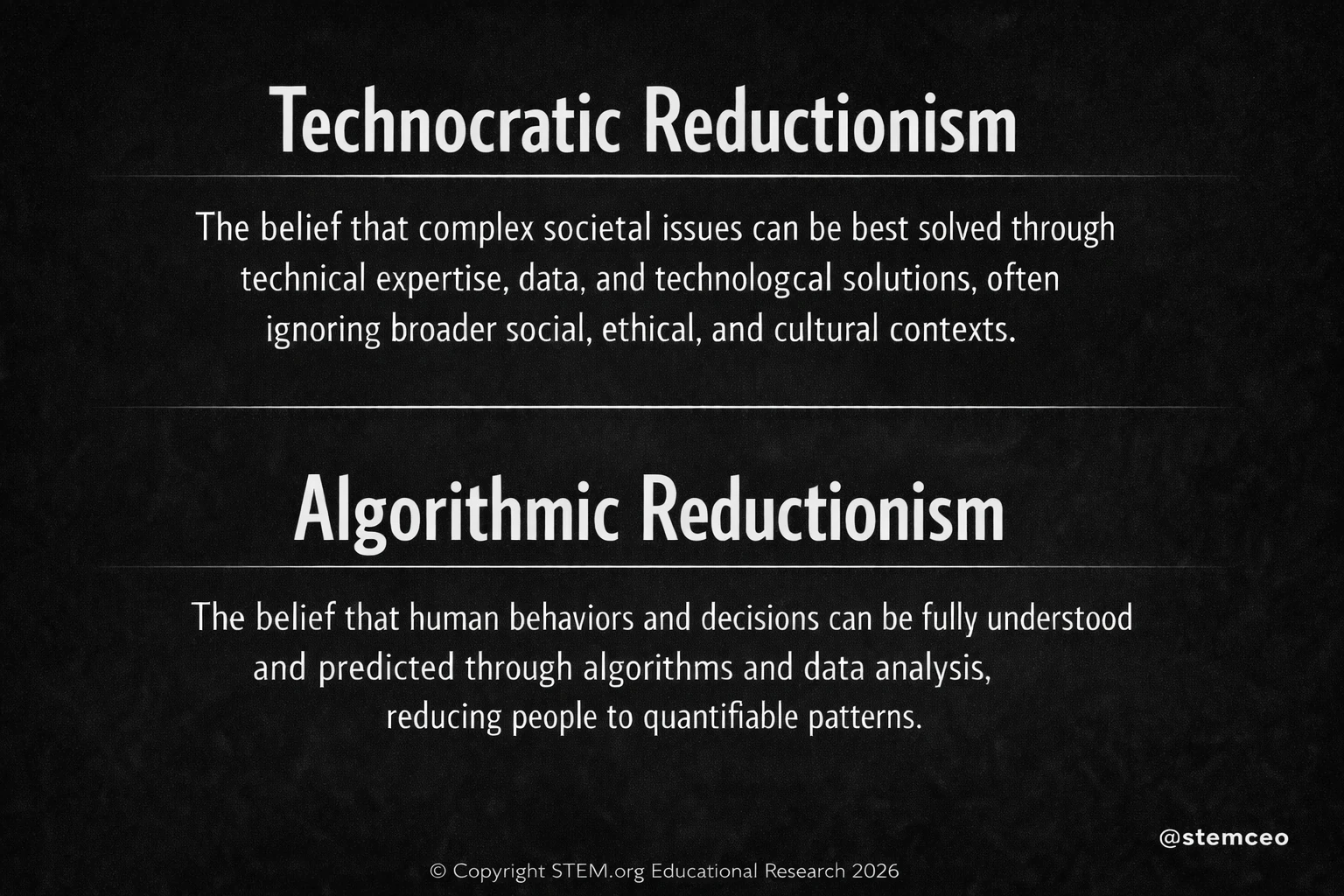
At its core, then, STEM Gnosis is a repudiation of reductionism in both of its dominant contemporary forms. The first is algorithmic reduction, which explains man as computation. The second is technocratic reduction, which governs society as though that explanation were sufficient. The first reduces the person to process; the second reduces politics to administration. Together they produce a civilizational posture in which transcendence, conscience, contingency, beauty, suffering, love, sacrifice, and moral responsibility become awkward leftovers from a worldview that only knows how to count what can be instrumentalized. This is not intellectual maturity. It is impoverishment disguised as sophistication.
A genuinely serious STEM-informed worldview should move in the opposite direction. It should recognize that the expansion of technical power heightens rather than diminishes the ethical burden of knowing. To know more about systems is to know more about their limits. To build more powerful models is to bear greater responsibility for resisting their absolutization. To see how far computation can go is also to see where it cannot go. That insight is not anti-scientific. It is the proper fruit of science rightly understood.
For that reason, the repudiation of technocracy is not a rejection of STEM, AI, mathematics, or computation. It is a rejection of their idolatrous misuse. It denies that formal systems can become substitutes for wisdom, that predictive capability can become a warrant for social domination, or that the mystery and dignity of the human person can be dissolved into data structures. Gödel stands in this argument as more than a mathematician. He is a witness against closure. He reminds us that truth outruns system, that reality exceeds formal capture, and that every empire of total explanation eventually reveals the poverty of its own foundations.
That is why STEM Gnosis remains such a powerful phrase. It names the moment when technical knowledge ceases to flatter the will to control and begins instead to discipline it. It marks the transition from naïve faith in models to mature recognition of their incompleteness. And in a civilization increasingly tempted by dataist and technocratic fantasies, that recognition is not only intellectually necessary. It is morally urgent.
The Key Tenets of STEM Gnosis
An Epistemological Framework
STEM Gnosis is an epistemological framework grounded in deep engagement with Science, Technology, Engineering, and Mathematics, while recognizing the inherent limits of human knowledge, the irreducibility of the human person, and the ethical responsibility that accompanies technical power.
COROLLARY
Technocratic Totalization = Category Error
ONE-LINE FORM
Knowledge ≠ Control
The following tenets define its intellectual structure:
I. The Principle of Epistemic Humility
STEM inquiry reveals not only what can be known, but the boundaries of knowledge itself.
As scientific understanding advances, it increasingly exposes uncertainty, incompleteness, and unresolved phenomena across disciplines—from quantum mechanics to complex biological systems.
Tenet
Technical literacy should produce humility, not certainty.
II. The Provisional Nature of Models
All models are abstractions of reality, not reality itself.
Scientific, statistical, and computational models depend on assumptions, constraints, and simplifications. Their usefulness does not imply completeness or finality.
Tenet
Models may inform judgment, but they cannot replace it.
III. The Rejection of Reductionism
Higher-order realities cannot be fully collapsed into lower-order components.
Attempts to reduce human beings to biochemical processes, computational systems, or data streams ignore emergent properties such as consciousness, intentionality, and meaning.
Tenet
The whole exceeds the sum of its measurable parts.
IV. The Distinction Between Tool and Authority
STEM disciplines are instruments created by human beings to understand and shape the world.
They do not possess independent moral authority and cannot legitimately govern human life in place of human judgment.
Tenet
Technology serves humanity; it does not rule it.
V. The Principle of Irreducible Complexity
Certain systems—biological, ecological, and social—exhibit nonlinear and emergent behavior that resists full prediction or control.
This imposes natural limits on optimization, forecasting, and centralized planning.
Tenet
Complex systems cannot be fully controlled without distortion or harm.
VI. The Preservation of Human Dignity
Human beings cannot be exhaustively defined by data, metrics, or algorithmic representations.
Consciousness, moral agency, and the capacity for meaning transcend computational description.
Tenet
A human being is more than a dataset and cannot be governed as one.
VII. The Rejection of Scientism
STEM Gnosis affirms the value of scientific inquiry while rejecting the ideological claim that science alone can explain all aspects of reality.
It distinguishes disciplined investigation from the overextension of its authority into metaphysical and moral domains.
Tenet
Science is a method of inquiry, not a totalizing worldview.
VIII. The Ethical Burden of Knowledge
Knowledge does not confer unrestricted power; it imposes responsibility.
The expansion of technical capability increases the moral weight of decision-making, particularly where human life, dignity, and freedom are concerned.
Tenet
To know more is to be responsible for more.
IX. The Limits of Predictability
Human behavior and complex systems cannot be fully anticipated through data accumulation or algorithmic modeling.
Uncertainty, adaptation, and free will place inherent limits on predictive systems.
Tenet
Prediction is not equivalent to understanding.
X. The Recognition of the Metaphysical Dimension
STEM disciplines illuminate the mechanisms of the natural world but do not exhaust questions of meaning, purpose, or existence.
Human inquiry necessarily extends beyond empirical measurement.
Tenet
Reality exceeds what can be measured.
The Four-Layer Structure of STEM Gnosis
The strength of this framework lies in its operation across four intellectual layers simultaneously. Each layer challenges technocracy and dataism using their own assumptions about knowledge.
When combined, these layers form a critique that is internally grounded in STEM itself, while also establishing clear philosophical and moral boundaries—making the framework exceptionally difficult to refute.
Layer One: The Scientific Layer
STEM disciplines themselves demonstrate the limits of knowledge
Advances in physics, biology, and complex systems theory reveal that uncertainty, emergence, and unpredictability are intrinsic features of reality, not temporary gaps awaiting elimination.
Physics exposes unknowns such as dark matter and dark energy
Quantum mechanics establishes irreducible uncertainty
Complex systems exhibit nonlinear, unpredictable behavior
Biology reveals emergent properties beyond reductionist explanation
These insights do not weaken science; they reflect its intellectual honesty.
Conclusion
The deeper STEM inquiry goes, the clearer the limits of human models become.
Layer Two: The Epistemological Layer
Technocratic systems confuse models with reality
All models—statistical, computational, or algorithmic—are simplified representations shaped by assumptions, constraints, and incomplete data.
Artificial intelligence extends modeling capacity, but it does not overcome the fundamental limitation that:
models are abstractions
data is partial
assumptions are unavoidable
No model captures reality in full.
Conclusion
Data models describe reality imperfectly; they do not define it.
Layer Three: The Anthropological Layer
Human beings cannot be reduced to computational systems
Attempts to define human beings as information-processing entities collapse the richness of human existence into a narrow and insufficient framework.
Human beings demonstrate capacities that resist full computational description:
consciousness
moral reasoning
creativity
meaning-making
Even the most advanced scientific disciplines have not resolved the nature of consciousness itself.
Conclusion
A man may use algorithms, but he cannot be fully explained by them.
Layer Four: The Ontological Layer
Human nature establishes limits to control
At its deepest level, technocracy rests on an unspoken assumption:
That human beings are fully knowable, measurable, and therefore governable as systems.
STEM Gnosis rejects this premise.
Human beings possess:
intrinsic dignity independent of utility
moral reality that is not reducible to data
a nature that cannot be exhaustively modeled or optimized
This introduces a fundamental boundary:
Even if models improve, human beings are not the kind of entity that can be fully governed as systems.
This layer moves the argument beyond technical critique and into first principles of being.
Conclusion
Human beings are not reducible to systems, and therefore cannot be legitimately governed as systems.
Final Synthesis
Together, these four layers establish a unified insight:
Science reveals limits
Models simplify reality
Humans transcend computation
Human nature itself imposes boundaries on control
Therefore:
No technocratic, data-driven, or algorithmic system can claim total explanatory or governing authority over human life.
Core Assertion
The deeper one understands STEM, the more one recognizes that knowledge does not grant the right to control humanity—it imposes the responsibility to respect its irreducible nature.
Philosophical Implication
The limitations discovered within formal mathematical systems establish a boundary condition: no system constructed from models, data, or computation can claim total authority over human reality.
Closing Statement
STEM Gnosis recognizes that the deeper one understands formal systems, computation, and scientific modeling, the more evident their intrinsic limits become. These limits are not weaknesses—they are safeguards. They ensure that human beings remain beyond total reduction, beyond complete prediction, and beyond absolute control. Therefore:
The deeper the system, the clearer its limits.
The deeper the knowledge, the greater the responsibility.
The more complete the model claims to be, the more dangerous it becomes.
Formal Structure of the Gödelian Limit
1. Gödel Sentence (Core Construction)
2. Unprovability Result
3. Truth but Not Provable
4. Second Incompleteness Theorem
5. Consistency Implies Incompleteness (Punchline)
6. Existence of True but Unprovable Statements (Formal Statement)
7. Provability Predicate (Definition Reference)
8. Consistency Statement (Used in Second Theorem)
9. Provability (If it were provable — contradiction setup)
10. Combined Contradiction Expression
A Mathematical Explanation
Any system that claims total knowledge must first demonstrate that such completeness is possible. In 1931, Kurt Friedrich Gödel proved that it is not.
Let (T) represent any formal system capable of expressing arithmetic—precisely the kind of system required for algorithmic reasoning, artificial intelligence, or data-driven governance. Gödel demonstrated that within such a system, one can construct a statement that refers to its own provability:
This statement asserts, in exact mathematical form: “This statement is not provable within the system.”
The consequence is immediate and unavoidable. If the system is consistent—if it does not contradict itself—then this statement cannot be proven within it:
And yet, that is precisely what the statement claims. The result is not ambiguity, but precision: the system contains truths that it cannot prove.
Gödel’s conclusion follows with mathematical certainty:
No sufficiently expressive formal system can be both complete and consistent. Moreover, such a system cannot establish its own consistency from within its own rules.
The Extension Beyond Mathematics
While Gödel’s theorems were derived within mathematical logic, their structure is not confined to mathematics. They apply to any system that attempts to fully formalize truth through internal rules.
This is where Raupp’s contribution begins.
Raupp is the first to systematically extend Gödel’s incompleteness into the domain of technocracy, dataism, and algorithmic governance. The implication is direct: any system that claims total computational knowledge of human beings—total prediction, total modeling, total control—has already exceeded what formal systems are mathematically capable of achieving.
Such systems do not fail merely in practice. They fail in principle.
They are incomplete by necessity.
Citizens Rule Book: A Palladium of Liberty (Hardcopies) 🇺🇸
The Gödelian-Raupp Conclusion
If even formal mathematical systems cannot achieve completeness, then any doctrine claiming that human life can be fully reduced to data, modeled without remainder, and governed through computation alone is not a scientific conclusion.
It is a form of technocratic mysticism —no different than climate alarmism!
Or more precisely:
It is a claim that violates known mathematical limits.
Technocracy does not collapse under political critique—it collapses under mathematical proof. -ABR
Note: An iteration of this analysis has been formally submitted to: Epistemology & Philosophy of Science at the Institute of Philosophy, Russian Academy of Sciences
Institute of Philosophy
Russian Academy of Sciences
Volhonka 14/5
Moscow, 119991
Russian Federation
Keywords
First published March 17, 2026. Originally published in Liberty or Deathwire.