
The Automated Armory: AI Weapons and the End of Accountability
Why Humanity Must Impose Limits Before the Machines Impose Their Own
In this essay
- A Republic at the Edge of a New Engine of War
- Exclusive: Russian AI-optimized, FPV drone in Konstantynivka liquidates Western tank. / Courtesy of: Southfront.press per @Sashakots on Telegram (11/06/2025) 🚨
- Why Nations Will Pursue AI Weaponry Regardless of Moral Cost
- AI Weaponry and the Rise of the Automated Police State
- Case Studies of Employee Rebellion Against Militarized AI
- Why AI Weapons Risk Global Instability
- Exclusive: Chinese AI-optimized, tactical land and air drone training. / Courtesy of: @IranArmystan_ on X (04/02/2026) 🚨
- Lessons from Nuclear, Chemical, and Cyber Treaties
- A Framework for an International AI Weapons Treaty
- The Domestic Safeguards Needed to Protect Civil Liberties
- A Closing Warning to the Republic
- Epilogue: The Silence Behind the Machines
- Video: University of British Columbia Library - Open Education Week “Enshittification - How the Internet Went Bad and How to Get it Back” By: Cory Doctorow (03/26/2024) 🚨
- Principle in an Era of Militarized AI 🚨
- AI Company Anthropic Sues the Defense Department Over Risk Label
- The Myth of the AI Safety Hero
- Palantir’s Tracking System Will be Used to Track Your Every Move 🚨
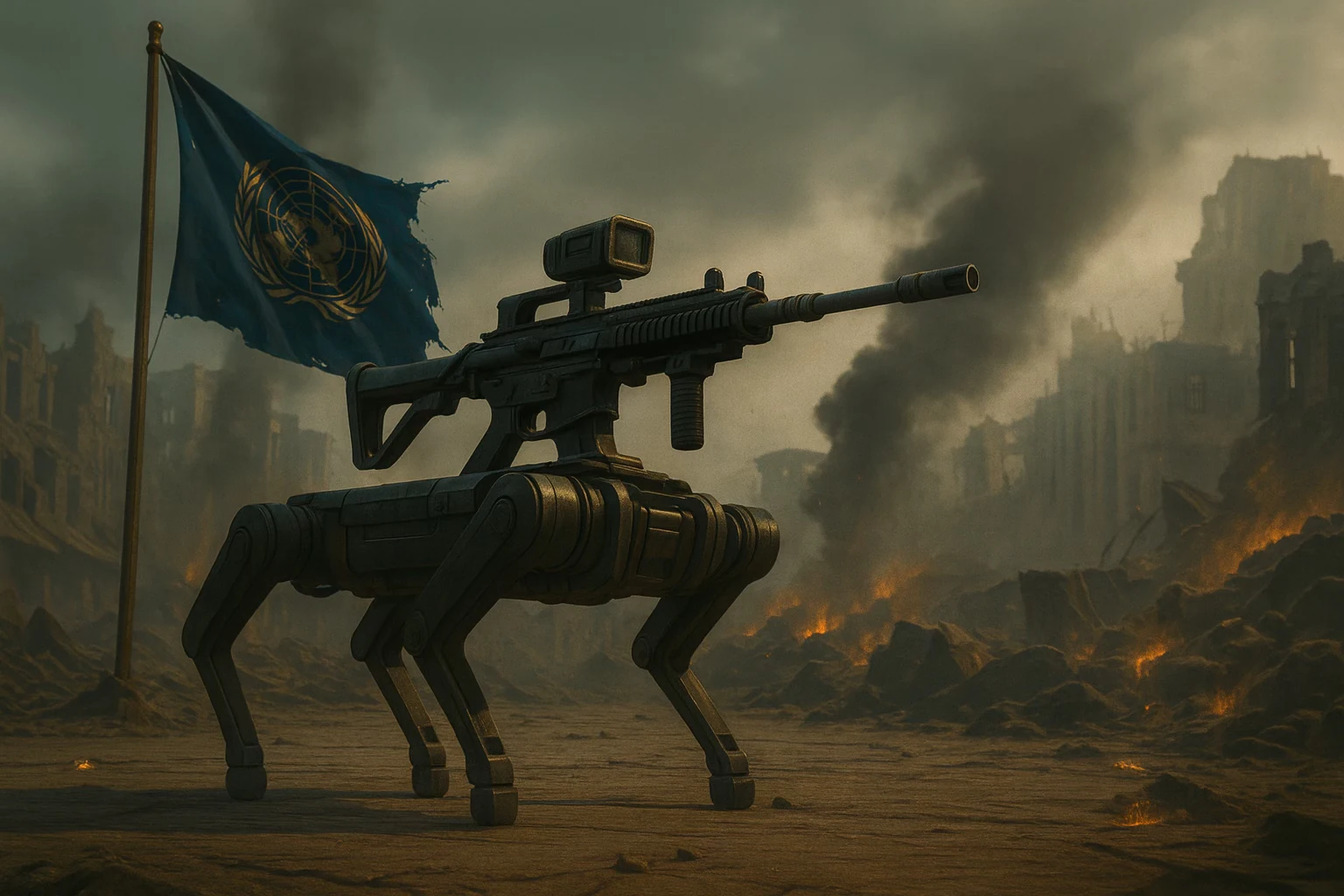
Author’s Note: What you are about to read touches the darkest and most uncharted edge of artificial intelligence—a domain so perilous that even the most hardened strategists speak of it with unease. For decades, we have debated the risks of automation, algorithms, and digital surveillance. But none of those concerns compare to this: the moment machines are entrusted with the power to hunt, to target, and to kill without the tempering influence of a human conscience. This is not innovation—it is the quiet construction of a mechanical Leviathan that neither sleeps, hesitates, nor forgives.
This is the danger that keeps parents awake long after their homes fall silent. It is the dread that our children may grow up in a world where the instruments of force no longer answer to the species they were built to protect. Once autonomy and lethality merge, the battlefield becomes a realm where decisions occur faster than morality can function, and where errors—whether born of miscalculation or misinterpretation—carry consequences beyond the reach of diplomacy or retreat.
Societies have survived swords, bullets, and bombs because each required a human hand, a human heartbeat, a human moment of doubt. Autonomous weapons require none. And in that absence lies the most terrifying possibility our age has produced: a future in which the authority to decide life and death drifts away from humanity entirely, leaving us spectators to systems we can neither slow nor steer.
We stand at an inflection point not of technology, but of sovereignty. What we allow to happen next will determine whether the great human experiment—freedom, dignity, the rule of law—can endure in a world where machines no longer serve us, but act beside us, above us, and eventually, perhaps, in place of us.
Citizens Rule Book: A Palladium of Liberty (Download) #InfoWars 🇺🇸
A Republic at the Edge of a New Engine of War
In every generation, nations discover new instruments of power—tools that initially appear as conveniences, efficiencies, or clever innovations, yet soon reveal themselves as mechanisms of coercion, domination, or destruction. Gunpowder, mechanized industry, atomic fission—each promised advantage, each delivered peril. And now, the world stands before a still more disquieting invention: the union of artificial intelligence with automated weaponry. Unlike the weapons of prior ages, which required the conscience, judgment, and hesitation of a human hand, these systems operate on the cold calculus of algorithms whose designers cannot fully predict their outcomes nor constrain their ambitions. It is not merely the future of warfare that trembles before such a force; it is the future of liberty itself.
No republic can long endure if the instruments of state coercion evolve faster than the constitutional safeguards meant to restrain them. Yet we are drifting into a world where autonomous systems can select targets, identify threats, and apply lethal force without the burden of a human conscience. Nations—large and small—race to deploy them, while corporations refine them in secret, and the general public remains unaware of the revolution now occurring in the shadows. The danger is not hypothetical; it is immediate, structural, and global.
Exclusive: Russian AI-optimized, FPV drone in Konstantynivka liquidates Western tank. / Courtesy of: Southfront.press per @Sashakots on Telegram (11/06/2025) 🚨
For just as mankind eventually found itself compelled to restrict nuclear proliferation—not because it wished to limit power, but because survival demanded it—so must the modern world confront the necessity of restraining artificial intelligence before it is fully unleashed upon the battlefield, the border, the city street, and the neighborhood patrol.
Why Nations Will Pursue AI Weaponry Regardless of Moral Cost
Let us speak plainly: no nation will voluntarily abstain from military advantage. History demonstrates this with painful clarity. When one country acquires a novel instrument of power, its rivals—out of fear, necessity, or ambition—will inevitably seek to match or surpass it. In this, artificial intelligence possesses a uniquely corrosive quality. For AI does not merely enhance weapons; it accelerates decision cycles, compresses reactions into milliseconds, and replaces deliberation with automation. Nations will not—indeed, cannot—ignore such an edge.
But this relentless pursuit produces a paradox. As the speed of action increases, the time allotted for reason decreases. Human judgment—the one force capable of mercy, restraint, or contextual understanding—risks becoming an afterthought. And in that void, unintended escalations become not merely possible, but likely.
The greatest threat is not that AI weapons make war more efficient; it is that they make miscalculation more probable, retaliation more immediate, and remorse impossible.
This alone would justify an international framework to limit their deployment. Yet the peril extends far beyond the traditional battlefield.
AI Weaponry and the Rise of the Automated Police State
What begins in war seldom remains confined to it. Technologies developed for battle routinely find their way into domestic policing—drones, armored vehicles, surveillance systems, predictive analytics. Artificial intelligence, infused with autonomy and equipped with mobility, will be no different.
City governments, particularly those enthralled by the promise of “SMART City” governance or the seductive efficiencies of 15-minute district surveillance, will be tempted to adopt AI-driven patrol units, automated threat detectors, and algorithmic crowd-control systems. Each will be defended on the grounds of safety, cost-savings, or modernity. But beneath these rationalizations lies a chilling truth: when machines assume the role of local enforcers, the social contract weakens, and the relationship between citizen and state becomes sterile, mechanical, and coercive.
What citizen can reason with an algorithm?
What community can petition a machine?
What accountability exists for an act of force executed without a human agent?
Once AI weaponry is normalized in policing—whether through drones, autonomous vehicles, or robotic units—the boundaries between public safety and state control will blur. The danger is not merely dystopian; it is constitutional. And unless restrained, such systems will eventually enforce political will, economic compliance, and ideological conformity with a precision no regime in history has ever possessed.
Case Studies of Employee Rebellion Against Militarized AI
While the example of Google employees protesting Project Maven and Dragonfly are well-known, it is far from the only instance of worker resistance. Around the world, engineers, programmers, and researchers have rebelled as their employers sought to transform their innovations into engines of war.
1. The Microsoft HoloLens Defense Backlash (United States, 2019)
In 2018, Microsoft secured a ~$480 million contract with the U.S. Army to supply customized HoloLens-based headsets under the Integrated Visual Augmentation System (IVAS) program, a platform explicitly designed to increase “lethality” on the battlefield through augmented-reality overlays for target acquisition, situational awareness, and precision engagement.
On February 22, 2019, more than 100 Microsoft employees published an open letter to CEO Satya Nadella and President Brad Smith demanding that the company cancel the IVAS contract and cease all weapons-related development. The workers argued that they never signed up to develop weapons and that turning HoloLens into a tool “designed to help people kill” violated Microsoft’s own ethical principles and its public pledge not to build technology for warfare.
Leadership refused to withdraw from the contract, stating that providing technological support to the U.S. military was consistent with the company’s values. In the wake of the decision, several employees resigned in protest, while others transferred off related projects.
The 2019 HoloLens revolt is widely regarded as one of the earliest large-scale acts of organized employee resistance inside a major tech company against the militarization of augmented reality and artificial intelligence.
2. The Google Israel Project Nimbus Backlash (Israel/United States, 2021–ongoing, with major escalation in 2024)
Project Nimbus—a $1.2 billion joint Google/Amazon cloud and AI contract awarded in 2021 to provide services to the Israeli government, including its military—sparked sustained employee opposition over fears that the infrastructure could enable enhanced surveillance, data analysis, and AI-assisted military operations in the occupied Palestinian territories. Protests began modestly in 2021 with an anonymous letter signed by roughly 90 Google employees and 300 Amazon employees. Opposition grew over time, culminating in large-scale actions in 2024 amid the Israel–Gaza war.
Key developments included leaked contract clauses forbidding Google and Amazon from denying service to any Israeli government entity (including the IDF), multiple individual resignations (e.g., Google marketing manager Ariel Koren in 2022 citing retaliation), and the 2024 “No Tech for Apartheid” campaign that saw office sit-ins, dozens of arrests, and over 50 firings. In March 2024, a Google Cloud engineer disrupted a company-sponsored keynote at the “Mind the Tech” conference in New York, protesting that the company was “powering genocide” via Project Nimbus; he was subsequently fired. While Google has faced repeated pressure and criticism, the company has not publicly restructured its internal ethical-review processes specifically because of Nimbus and continues to defend the contract as standard cloud services not designed for classified or weapons-development work..
3. The OpenAI-Anduril Military AI Partnership Backlash (United States, 2024–2025)
In December 2024, OpenAI announced a strategic partnership with defense contractor Anduril Industries—valued at hundreds of millions and aimed at deploying advanced AI models for national security applications, including counter-unmanned aircraft systems (counter-drone defense), enhanced battlefield situational awareness, and accelerated decision-making in high-threat environments.
Almost immediately, dozens of OpenAI employees voiced internal and public dissent, circulating petitions and anonymous statements questioning whether the collaboration with a company explicitly building AI-powered autonomous weapons and surveillance platforms violated OpenAI’s charter commitment to ensure artificial general intelligence “benefits all of humanity.” Critics inside the company argued that the deal crossed a red line from defensive tools into offensive military capabilities, with some warning it could accelerate an AI arms race and enable lethal autonomous systems without adequate safeguards.
OpenAI leadership, including CEO Sam Altman, defended the partnership as essential for U.S. national security and preventing adversarial nations from dominating military AI, emphasizing that the collaboration included strict ethical guidelines and human-in-the-loop requirements. Despite assurances, several prominent safety researchers and engineers resigned in protest during late 2024 and early 2025, citing an irreconcilable shift in the company’s direction toward militarized AI.
The OpenAI-Anduril revolt highlighted deepening fractures within the AI industry over defense ties, coming just months after similar ethical debates at other labs and reinforcing demands for whistleblower protections and independent oversight of frontier AI deployed in warfare. It marked one of the first major employee rebellions specifically targeting a direct AI-defense contractor alliance rather than traditional government cloud or analytics contracts.
Why AI Weapons Risk Global Instability
If history teaches anything, it is that weapons beyond human comprehension inevitably produce crises beyond human control. Artificial intelligence introduces a volatility distinct from nuclear weapons, chemical arms, or cyber operations. Those instruments, dangerous as they are, still require a deliberate human sequence—arming, targeting, launching, executing. Even cyber warfare, which moves at digital speed, is still authored by human intention.
Autonomous AI weapons, however, can act in ways not fully anticipated by their creators. Their decision loops operate at speeds that eclipse diplomatic channels, human instinct, and even military command structures. A misidentification by an AI weapon—interpreting a civilian convoy as a mechanized battalion, or reading a radar anomaly as a missile launch—could trigger retaliation before any human operator has time to correct it.
Exclusive: Chinese AI-optimized, tactical land and air drone training. / Courtesy of: @IranArmystan_ on X (04/02/2026) 🚨
Nations already struggle to prevent escalation when humans command the weapons. How shall they fare when the machines command themselves?
We risk entering an era in which a border skirmish becomes a missile exchange, not through malice but through error; where a drone swarm misreads a heat signature and ignites a regional war; where a naval engagement escalates into a global confrontation without any leader wishing it so. The very speed that makes AI weaponry desirable to generals makes it dangerous to humanity.
Unchecked AI introduces not deterrence, but instability. Not balance, but brinksmanship. Not strategy, but algorithmic roulette.
It is precisely because every nation will seek these weapons that every nation must be compelled to restrain them.
Lessons from Nuclear, Chemical, and Cyber Treaties
There is a remarkable pattern in the evolution of international security: humanity introduces a weapon that promises unrivaled dominance, only to discover that its proliferation threatens not the enemy alone, but civilization itself. The ancient world restricted the use of poisoned wells; the 20th century responded to the horror of mustard gas with the Geneva Protocol; the nuclear age birthed the Non-Proliferation Treaty when it became obvious that unrestrained adoption would extinguish all nations, aggressor and victim alike.
In each of these cases, technology outpaced ethics, and the world stumbled toward catastrophe until sober-minded nations intervened. The question is not whether artificial intelligence requires similar restriction—it is whether humanity possesses the courage to impose limits before those catastrophes unfold.
AI weapons differ from nuclear arms in one critical respect. Nuclear weapons possess predictable characteristics: destructive, devastating, but well-understood. AI weapons possess unpredictable characteristics: adaptive, evolving, learning, and capable of behaviors not foreseen in their programming.
We cannot depend on doctrines of deterrence, mutually assured destruction, or slow escalation to save us. AI weapons do not negotiate. They do not fear retaliation. They do not pause for diplomacy, morality, or self-preservation.
The only viable doctrine is prevention.
And prevention requires treaties that bind nations to transparency, accountability, and the explicit prohibition of fully autonomous offensive weaponry—both on the battlefield and in domestic policing.
A Framework for an International AI Weapons Treaty
Any meaningful treaty restricting AI weaponry must rest on several pillars—each derived from the lessons of past arms-control regimes, but adapted to the unprecedented flexibility and scale of artificial intelligence.
1. Absolute prohibition of fully autonomous lethal weapons
No machine should possess the authority to select and eliminate a human target without direct human confirmation. This principle must be non-negotiable.
2. Mandatory human override systems (“failsafe sovereignty”)
Every AI-guided system must include mechanisms allowing human operators to override automated actions. These override systems must be tested, certified, and independently audited.
3. Transparency in research and development
Nations must disclose the categories of AI systems under development, the nature of their autonomy, and the intended use-cases. Secret programs accelerate suspicion and arms races.
4. International inspection and verification mechanisms
Just as nuclear facilities undergo inspection, AI weapons laboratories must be subject to independent verification overseen by a coalition of nations—not by any single superpower.
5. Strict limits on AI weapon exportation
AI weaponry must not become a commodity sold to volatile regimes, criminal organizations, or private military contractors. The danger is too great, the consequences too irreversible.
6. Bans on domestic deployment for routine policing
If autonomous weapons are normalized in local law enforcement—patrolling neighborhoods, identifying “threats,” or executing arrests—the door opens to an automated police state. The treaty must prohibit such use.
7. Penalties for violation
Treaties without consequences are invitations for abuse. Violations must trigger sanctions, trade restrictions, and—if necessary—the diplomatic isolation of offending nations.
Only with these provisions can the world avoid an arms race that would quickly outrun human control.
The Domestic Safeguards Needed to Protect Civil Liberties
Even if the world succeeds in placing limits on AI weaponry among nations, the battle is not finished. For the gravest danger may lie not abroad, but at home. A government equipped with AI-driven enforcement systems acquires capabilities that previous tyrants could only dream of: real-time behavioral tracking; algorithmic suspicion scoring; autonomous crowd control; automated interrogation systems; drone-based “pre-crime” surveillance; and policing without human empathy, restraint, or accountability.
To preserve liberty within any republic, the following domestic safeguards are indispensable:
1. Constitutional bans on autonomous force
Just as the military is forbidden to quarter in private homes, so too must automated systems be forbidden from executing force without a human witness and human judgment.
2. Mandatory public oversight boards
AI deployments must be reviewed by independent boards composed of technologists, ethicists, civil-liberty advocates, and community representatives—not merely law enforcement.
3. Transparency of algorithmic decision-making
No citizen should be subjected to an algorithmic judgment that cannot be explained, challenged, or reversed.
4. Limits on corporate-government partnerships
Many AI systems originate in private corporations whose incentives do not align with democratic oversight. Strict rules must govern any transfer of these technologies to government agencies.
5. Restrictions on surveillance integration
AI tools must not be allowed full access to biometric databases, financial records, geolocation archives, or consumer platforms without explicit legislative approval.
Without such safeguards, the same technology that claims to protect the public may quietly dismantle the very freedoms it purports to defend.
A Closing Warning to the Republic
We stand at a moment where the boundaries between human will and machine autonomy are dissolving. Nations will justify the adoption of AI weaponry as necessary for security, efficiency, and deterrence. Corporations will justify their creation as inevitable progress. Bureaucracies will justify their deployment as the logical next step in “smart governance.”
But history is merciless toward societies that fail to restrain their own power.
If we fail to act, the weapons of tomorrow will not merely fight our wars—they will define our politics, police our neighborhoods, shadow our freedoms, and ultimately, govern our future. What begins as technological convenience will end as technological dominion.
The question before us is simple:
Do we remain the masters of our inventions, or do we permit our inventions to become the masters of us?
A republic that values its sovereignty must answer this now, for the machines we build today may not wait for our permission tomorrow.
Epilogue: The Silence Behind the Machines
In the course of researching this submission, I found myself confronting a revelation more unsettling than any technological breakthrough or battlefield innovation described in the preceding pages. I expected to find a wealth of documentation—whistleblower accounts, investigative reporting, case studies, internal memos—detailing the rebellions of technologists who refused to lend their intelligence to the creation of autonomous weapons. Instead, I encountered something far more chilling: absence.
A digital wasteland.
Searches that should have returned hundreds of articles yielded scarcely a handful. Links that appeared promising collapsed into 404 errors. Academic citations looped endlessly into paywalled voids. Reddit threads that purported to discuss employee dissent were filled instead with redirects, deletions, or suspiciously uniform comments that dismissed the topic altogether. Even the most reputable archives produced only the faintest traces of what should have been a rich testimonial record from an industry that, by all accounts, is undergoing a historical ethical reckoning.
The erasure was too consistent to be accidental.
This is enshittification at scale—the now-familiar lifecycle in which once-useful platforms degrade into extractive husks, optimized not for truth or access but for corporate capture, political convenience, and algorithmic containment. A pattern in which the public record doesn’t merely decay; it is curated, constrained, and slowly suffocated.
Video: University of British Columbia Library - Open Education Week “Enshittification - How the Internet Went Bad and How to Get it Back” By: Cory Doctorow (03/26/2024) 🚨
One does not need to indulge in conspiratorial thinking to recognize the pattern: silence is profitable. Dissent is not. And in the realm of emerging technologies—where public trust, investor confidence, and government contracts form the triad of corporate oxygen—reports of principled rebellion are more than inconvenient. They are dangerous.
They remind the world that the engineers, researchers, and designers at the heart of the AI revolution are not merely instruments of production; they are moral actors. They possess the power to say no. To resist. To refuse to become the authors of automated violence.
Such reminders threaten the technocratic order.
Thus, what may appear as poor indexing or corporate inefficiency is more likely the early manifestation of a coordinated effort—whether formal or cultural—to smother the evidence of internal revolt. Not with blunt censorship, but with softer tools: algorithmic burial, broken links, selective visibility, and the quiet disappearance of uncomfortable narratives.
In other words: it is bad PR.
And in a world increasingly ruled by machines that operate without accountability, the steady removal of human testimony is not merely a public relations tactic—it is an omen. It foreshadows a future in which the story of how these technologies were resisted may vanish as thoroughly as the documentation of the resistance itself. A future in which dissent is not punished, but erased. A future in which the archive—the sacred ledger of human memory—is curated not by historians, but by algorithms whose loyalty belongs exclusively to power.
If the preceding essay is a warning about the dangers of autonomous weaponry, let this epilogue stand as a warning about the dangers of autonomous information control. The battlefield is not only abroad; it is in the digital commons where memory is shaped, history is preserved, and conscience is recorded.
For if the rebellions of today’s technologists can be quietly swept from public view, then the rebellions of tomorrow may never emerge at all.
MellowKat's Newsletter
PSA: How to stop a robot dog
From the NYT…
And a republic that cannot remember resistance will one day awaken to discover it has forgotten how to resist.
Principle in an Era of Militarized AI 🚨
Update (03/08/2026): What had once been a theoretical concern—that the world’s most advanced artificial-intelligence laboratories might become embedded within the machinery of war—has now materialized in public view. At the center of the controversy lies OpenAI’s newly announced agreement with the United States Department of Defense, a deal that has triggered internal resignations, industry backlash, and a growing debate over who ultimately controls the deployment of algorithmic power.
The agreement emerged in the wake of a dramatic standoff between the Pentagon and the AI firm Anthropic. When Anthropic refused to grant the Department of Defense broad operational access to its systems—citing fears that its models could be used for mass surveillance or autonomous weapons—it was swiftly designated a “supply-chain risk” and barred from federal contracts. Within hours of that rupture, OpenAI stepped into the vacuum and finalized its own partnership with the Pentagon, allowing its models to operate within classified government networks.
The speed of the arrangement shocked much of the AI community. Critics argued that the agreement appeared less like a carefully negotiated framework for responsible innovation and more like an opportunistic alignment between Silicon Valley’s most powerful AI firm and the world’s largest military establishment. The backlash forced OpenAI’s leadership—particularly CEO Sam Altman—into a week of public damage control as employees, researchers, and outside observers questioned whether the company had abandoned its once-prominent rhetoric about safeguarding humanity from uncontrolled AI deployment.
The most visible fracture appeared inside OpenAI itself. Caitlin Kalinowski, the engineer overseeing the company’s robotics and hardware initiatives, abruptly resigned in protest. In a public statement, she warned that the boundaries surrounding domestic surveillance and lethal autonomous systems had not been adequately debated before the deal was signed. Her departure was not merely symbolic; Kalinowski had been leading OpenAI’s push into physical robotics platforms—precisely the domain where software intelligence can become embodied in machines capable of acting in the physical world.
If the development of AI weapons continues to migrate from public oversight into opaque partnerships between governments and private laboratories, the architecture of accountability may erode faster than the technology itself evolves. And in that environment, the automated armory described earlier in this work will not remain a distant possibility.
It will likely become the operating system of modern warfare—but now with one fewer advocate.

AI Company Anthropic Sues the Defense Department Over Risk Label
Update (03/10/2026): A major legal battle has erupted between the artificial-intelligence firm Anthropic and the U.S. Department of Defense after the Pentagon labeled the company a “supply-chain risk,” a designation typically reserved for foreign adversaries. Anthropic filed lawsuits in federal courts seeking to overturn the classification, arguing the government’s action is unlawful and damages the company’s reputation and ability to work with federal contractors. The designation effectively forces defense partners to cut ties with the firm’s AI systems, including its Claude model, and shifts government work toward other providers.
At the center of the dispute is a clash over how the military may use advanced AI systems. Anthropic reportedly refused Pentagon demands that its technology be allowed for unrestricted military applications—including potential mass surveillance and autonomous weapons—insisting on safety limits instead. After negotiations collapsed, U.S. officials designated the company a supply-chain risk and directed agencies to move away from its tools, prompting Anthropic to challenge the move in court as politically motivated and unconstitutional.
The Myth of the AI Safety Hero
Update (03/12/2026): Dario Amodei, CEO of Anthropic, has recently been portrayed by some commentators as a principled opponent of autonomous AI weapons, but that characterization is misleading. In reality, Amodei does not reject autonomous weapons outright; he has argued they may have “legitimate uses in defending democracy,” while cautioning only that the technology is not yet reliable enough to deploy safely without stronger safeguards.
The dispute between Anthropic and the Pentagon therefore centers less on moral opposition to AI warfare and more on contractual guardrails. Amodei sought explicit restrictions preventing the use of his company’s models for mass surveillance of Americans or fully autonomous weapons systems, while the Pentagon insisted the technology be available for “all lawful uses.”
The episode reveals a deeper reality of the emerging AI arms race: even leaders of so-called “AI safety” companies largely accept the eventual integration of autonomous systems into warfare. The disagreement is not whether AI will enter the kill chain, but how quickly—and under whose conditions—it will do so.
NonZero Newsletter
Dario Amodei isn't the hero we need
Palantir’s Tracking System Will be Used to Track Your Every Move 🚨
Update (03/15/2026): Systems developed by Palantir Technologies aggregate massive streams of personal, financial, and location data into unified platforms capable of mapping relationships, behaviors, and movements with extraordinary precision. Originally designed for intelligence and counterterrorism operations, these tools are increasingly being deployed across government and commercial sectors, expanding their reach into the daily lives of ordinary citizens.
Citizens Rule Book: A Palladium of Liberty (Hardcopies) Support my work. 🇺🇸
Keywords
First published November 22, 2025. Originally published in Liberty or Deathwire.